
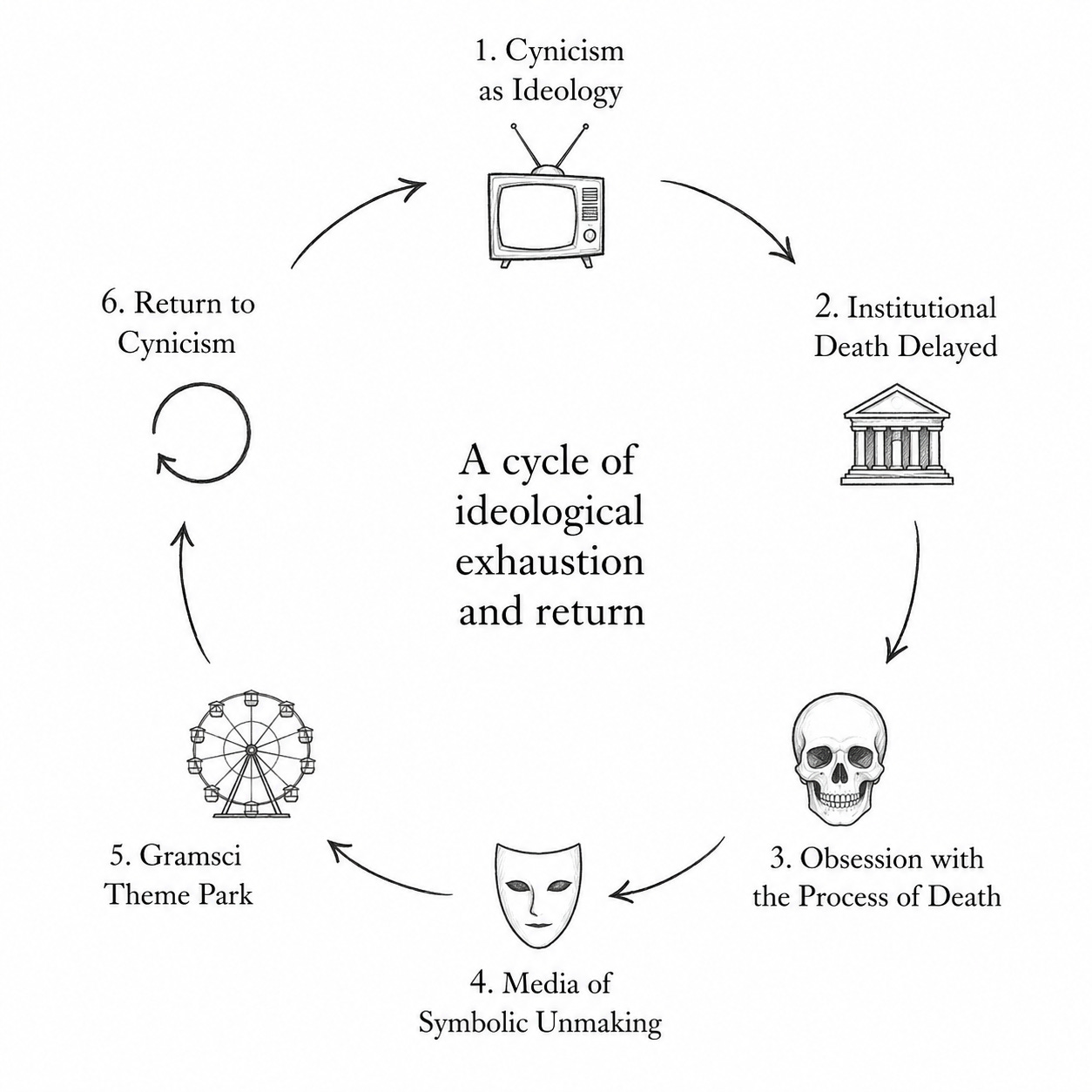
One of the most useful philosophies for understanding the weirding or polycrisis has been Žižek’s account of cynicism as ideology. According to Zizek, the cynical subject no longer needs to believe in the institutions and machines that surround him. He can recognize their contradictions, see the private interests behind their universal claims, and assume that their official language is largely a fiction, while continuing to participate in them because doing so remains advantageous, necessary, or simply easier than not participating. Paired with the familiar paraphrase of Gramsci’s interregnum –The old world is dying while the new one is struggling to be born…. – Cynicism is one of the ways the old world keeps functioning during the interval.
Versions of this diagnosis became more popular in the West starting circa 2015. It has been used to explain support for Trump: voters who treat the obvious artificiality, exaggeration, and grift as features rather than revelations capable of discrediting him. It has appeared in the discourse around bullshit jobs. It can also be used to explain elite overproduction and academia, where participants possess elaborate critiques of credentialism and institutional corruption, while continuing to compete intensely within those systems.
What follows cynicism is death. The canonical example for cynicism as ideology is the Soviet Union in the 70s and 80s. The recurring motif that has been popularized is Vaclav Havel’s shopkeeper who puts up the sign “Workers of the world, unite!”, but does so because he wants to be left alone to do business, not because he believes in it. Much less talked about are the Necrorealist movements and the scary poems popular at that time. In his book Everything Was Forever, Until It Was No More, Alexei Yurchak writes about the Necrorealist movement in 70s Soviet Union that was obsessed with making films and performances filled with corpses, zombies, purposeless violence, decomposition, and bodies suspended somewhere between life and death. Yurchak notes that these films and performances did not focus on the horror of death but on its absurdity and fascination with death as a process. This aesthetic emerged alongside an actual gerontocracy whose leaders appeared increasingly ancient and infirm while the political forms surrounding them remained fixed and monumental. The culture began producing images appropriate to a social order that could no longer be comfortably described as either alive or dead.
The Necrorealist movement seems to have been largely confined to the artistic class, but Yurchak identifies a popular form among ordinary Soviet citizens: “scary little poems,” strange verses that take mundane aspects of Soviet reality and render them uncannily violent, such as:
Alësha was cooking meat stew with no sound,
His daddy was legless and crawling around.A little girl found a grenade in the field.
“What is this, uncle?” with trust she appealed.
“Pull on the ring,” he said, “you will find out.”
For a while her bow will be flying about.A little boy Vitya played with a gun,
Taking it apart was tricky but fun.
His finger by accident pulled on the trigger,
His brain sprayed the ceiling with splatter and vigor.
Between these and various other examples Yurchak discusses, there seems to have been a fascination with the process of death as the Soviet Union made its way through the Gramsci Gap.
Gramsci’s formulation is useful because, as far as institutions are concerned, death is never a singular event. Political orders often remain recognizable long after the conditions that gave them coherence have disappeared. The Holy Roman Empire survived until 1800s in various strange and thin forms. The Habsburg monarchy lived through successive losses of territory, military defeats, nationalist movements, and changes in the European balance of power. By the time the empire met its end in 1918, its death had been underway for several generations.
Institutional death therefore creates a peculiar temporality. The old arrangement no longer possesses liveness; it may be undead as Zizek says, yet its architecture, bureaucracy, and incentives continue to organize everyday behavior. Contenders to replace the system exist but they do not arrive fully formed. People inhabit a world that can feel simultaneously permanent and terminal. The longer cynical participation keeps such an order operating, the longer the dying process can become.
As the interval lengthens, culture becomes increasingly interested in death as a process: decomposition, incapacitation, ruin and bodily transformation. Stephen King, writing about horror in Danse Macabre, calls this sensation “things in the unmaking.” We live in civilized societies where actual death and violence are removed from us. The dying are sent to old age homes in Valhalla like bucolic suburbs. The animals we eat are slaughtered industrially, far away from our sight. Even in modern warfare, death to enemies of the West happens through drones and missile strikes, not hand to hand combat. In such societies “things in the unmaking” is experienced day to day through media and hobbies that have an increasing pre-occupation with death.
This could explain why two apparently opposed forms of contemporary entertainment have become so powerful: horror movies and the UFC. One belongs largely to a liberal and artistic cultural world; the other has become conspicuously married to the populist right. The marriage happened on the White House lawn this summer. They had been dating for a while. Both horror films and UFC construct bounded environments in which audiences can approach symbolic death and watch bodies, identities, homes, families, and social order come apart. Horror, more obviously, gives us imaginary unmaking of order. UFC is a fight sport that famously started off as no-holds-barred violence but over the years has become a highly regulated machine. Perhaps because of its history and because of the literal damage done to the body, UFC offers symbolic death to its contestants and a stimulating dance of death for the viewer.

These are carnivalesque rehearsals for a condition that increasingly defines ordinary life: living inside institutions whose endings are easier to imagine than their successors. Let’s call these phenomena Gramsci Theme Parks.
Unmaking In The Cage vs The Dark
All sports are finite games in the James Carse sense, and as a result participants in the sport approach every game with a mentality of living and dying not winning and losing. But no professional sport actually takes the player and the spectator as close to death as UFC. Many fighters talk about “being willing to die out there” in almost literal terms. Here’s UFC fighter Julian Erosa talking about his mentality:
And I know I'm not going to legitimately die but you have that mindset going in there, and once you have that mindset stepping into that cage, nothing's gonna stop you. You have to get turned off. There are some guys you see, it almost seems like they're fighting not to lose instead of fighting to win and, for me, I think I had gotten a little complacent in my mind before a few fights. And the last few fights that I've had, I went in there with the do or die mentality and if you're gonna beat me, you're gonna have to turn me off
UFC itself is surrounded by an atmosphere of kayfabe reminiscent of Žižek’s ideological subject. Unlike professional boxing, MMA is not covered by the Ali Act’s protections separating the interests of promoters and managers, leaving the UFC with unusually concentrated control over matchmaking, promotion, and fighter contracts. The fights are preluded by theatrics, verbal warfare and the ritual manufacture of personal antagonism. Everyone involved knows, at least to some degree, that they are watching a promotional performance, but this knowledge does not make the antagonism any less effective. Like Zizek’s ideological subject, the audience knows very well that much of it is theater, and yet behaves as if the hatred were real. Inside the cage, you watch the symbolic unmaking and death of the fighter.
Analyzing the horror genre, Stephen King wrote in Danse Macabre that its most successful works locate what he called “national phobic pressure points”: fears and anxieties shared across large sections of society. Horror gives these otherwise diffuse anxieties a body. Nuclear war becomes the giant mutant, social breakdown becomes the zombie, and the predatory impulses are depicted as monsters. The audience is then given the pleasure of watching the fear become tangible enough to confront, escape, or destroy. Horror movies provide a bounded cathartic experience of unmaking and death.
One of the highest-grossing original films of 2025 was Weapons, a horror movie about an elderly witch, Aunt Gladys, who sustains herself by placing children and their parents under her spell. It is hard not to read the plot as an allegory for the American gerontocracy: an older generation extending its own life by draining the vitality and agency of people decades younger than itself. The movie ends with a cathartic reversal. The children are released from Gladys’s control, turn on her, chase her through an American suburb, and literally tear her apart with their little arms, breaking the spell in the process.

In the 90s and 2000s, much of the unmaking in media was through reality TV shows like To Catch a Predator or TV shows like X-Files, and now everyone in America is involved in either attempting to uncover a secret pedophile ring of the elite or attempting to prove that aliens are visiting us every day. The unmaking of the 90s and 2000s could be seen as a prelude to cynicism as ideology. People still believed that institutions could be unmade and put back together. But now we are pre-occupied with death that never comes.
The longer a culture remains preoccupied with death, the more likely death itself is to become an economy. Horror and the UFC are obvious cultural examples, but look more closely and much of contemporary culture operates in this logic. Scenes organize themselves around fantasies of killing particular monsters. The network-state scene imagines the death of the nation-state, crypto once imagined the death of the bank, anti-AI politics imagines the death of AI, accelerationists imagine the death of bureaucracy and human gatekeepers. The longevity movement goes one step further and declares war on death itself. But none of these cultural scenes have been able to make the terminal move that kills their chosen monster. So what we end up with are infinite games organized around the fantasy of death.
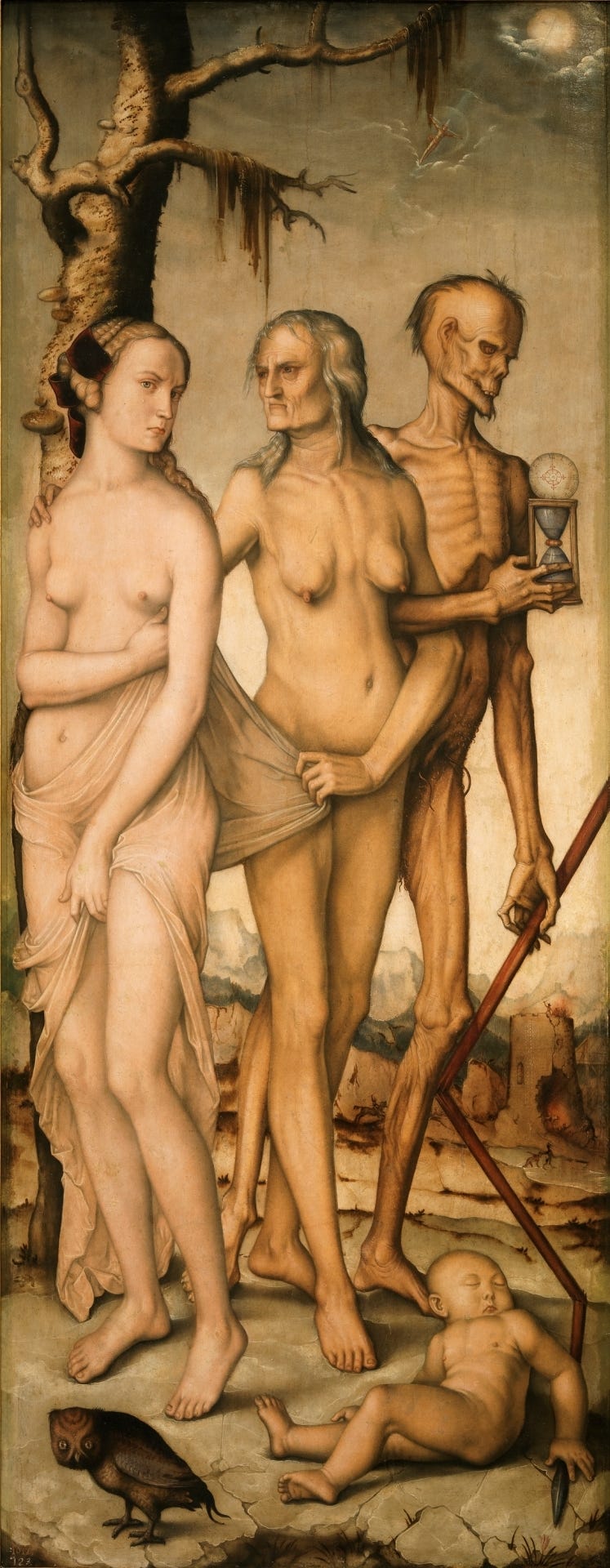
The medieval dance of death was a festival in which the normal order of society was temporarily upturned. It produced a Bakhtinian Carnival Time in which the powerful relinquished their titles temporarily and joined the ordinary people in honoring the dead. One of the central images that defined the carnival for Bakhtin was the pregnant old hag. An old woman who was at the same instant close to both death and birth. The danse macabre thus was an interval in which birth and death co-existed briefly, before regular time and order resumed. When death fails to arrive, all that is left is the multiplication of grotesque bodies of old pregnant hags waiting around for their time to come.
This is brilliant. I have been interested in various competing Frameworks for understanding the current historical moment, and this is a different paradigm, and very useful. I love the 1970s and '80s Russian dimension and learning about the necrorealists. Thanks!
damn, man. good insight gg