
Immutable Skills
How skills develop at higher levels of abstraction, and why fixed metaphors of knowledge are not enough
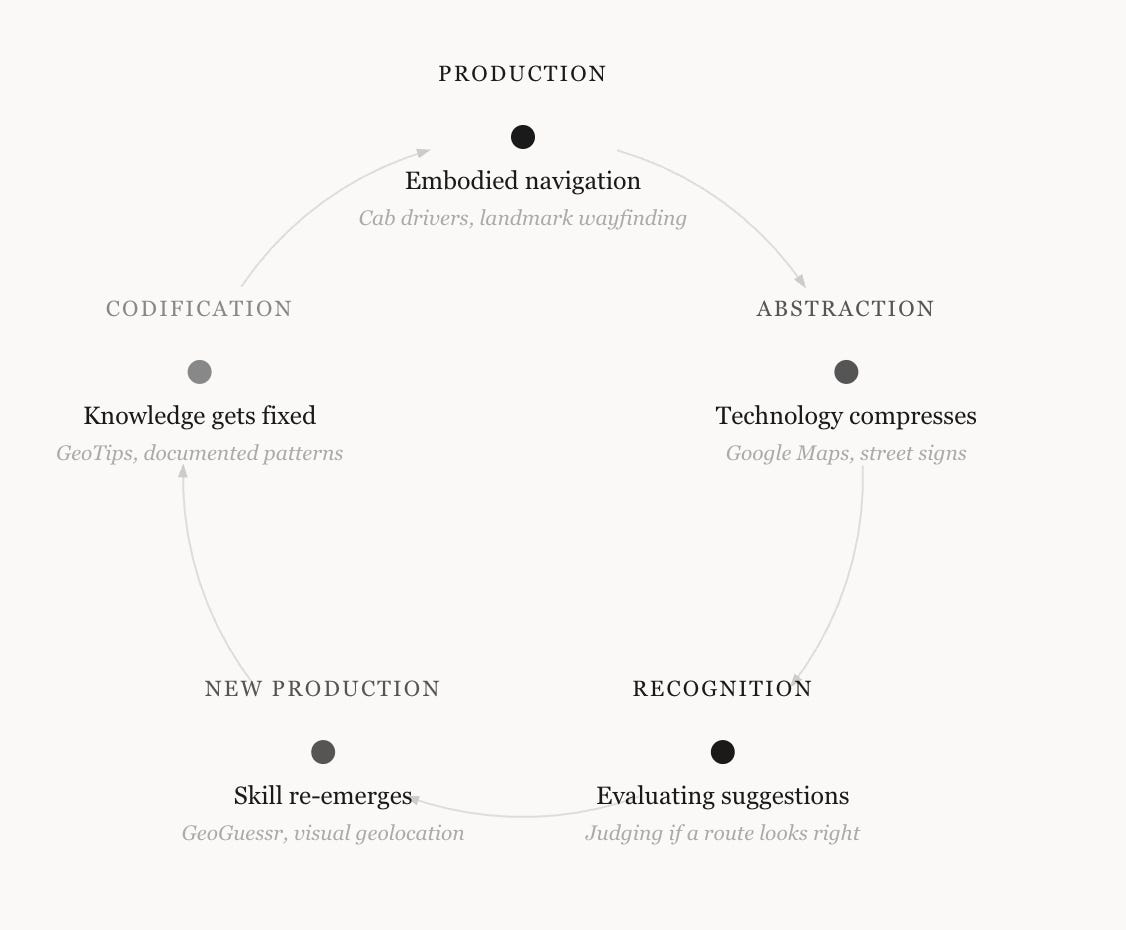
When I moved to the United States from India, one of the first things I did was learn to navigate roads in a completely unfamiliar way. I was used to navigating by landmarks, such as a corner store, or an odd looking rock, sometimes an obnoxious billboard. Street signs were not quite reliable and highway exit signs were non-existent. I went from navigating using spatial landmarks to navigating by words and signs in the United States. This to me is not that different from learning to type using Pinyin IME keyboards, where users type the romanized pronunciation of a word, and the system generates a list of candidate characters. The user then selects the correct one. The cognitive skill shifts from active recall (being able to reproduce a character stroke by stroke from memory) to passive recognition (being able to identify the correct character when you see it).
Both of these are examples of technologies (road signs and traffic protocols, IME keyboards) that shift the skill required from production to recognition. Instead of producing an internalized map of the city or the strokes of the characters, you get good at recognizing the right signs in a system.
New knowledge formation then happens at the recognition layer that has simplified a previous production layer. To see how, let’s look at navigation again.
There is a widely cited study by Eleanor Maguire from the year 2000 that found London cab drivers had significantly larger posterior hippocampi (the brain region associated with spatial memory) than control subjects, and that the enlargement correlated with years spent on the job. These drivers had spent years acquiring what is known in London as “The Knowledge,” an intimate, embodied familiarity with over twenty-five thousand streets, built up through repeated traversal on mopeds and tested through grueling oral exams. With the ubiquitous adoption of maps software on phones, that skill has all but become obsolete. Now most people, even ones who have lived in a city for a long time, navigate through signs and symbols on Google Maps. The production skill, constructing a route in your head from accumulated experience, has been replaced by a recognition skill: evaluating whether a suggested route looks right.
But interestingly, the wide availability of maps software combined with the massive visual coverage offered by Google Street View led to the emergence of an entirely new hobby: GeoGuessr. For those who don’t know, GeoGuessrs are individuals who guess the location of a photograph with terrifying accuracy and speed, often with very few cues to go off of (the species of a tree, the angle of shadows, the style of road markings, the shape of a utility pole). If you have not seen one of these videos, I suggest watching one before you read further. I don’t know of any studies done on the brains of GeoGuessrs, but it would be safe to guess that the results would be interesting.
So the skill of spatial memory went from knowledge of the local area, a mixture of explicit knowledge through maps plus embodied knowledge that came with experience, to a higher level of abstraction, where people who specialized in the skill of GeoGuessr could identify any place on the globe from a few visual cues. This new skill is now being documented in a form that you can teach yourself at sites like GeoTips. The spatial memory skill also went from being associated with labor (cabbies, delivery drivers, couriers) to a hobby that is now being professionalized through world championships and competitive leagues.
A similar transition is now happening in vibe coding, where people who may or may not have developed traditional coding skills are building software using tools like Claude Code and Codex. Instead of learning the skills at the local level of the programming language (syntax, data structures, debugging), there is new skill formation happening at the higher abstraction layer of managing dozens of coding agents. In this process, some of the skills that were associated with labor, such as building websites or small apps, will become hobbies. And a new layer of professionalization will emerge at the layer of managing agents, crafting system prompts, and curating skill packs.
The advantage of skills moving from the realm of production (handwriting code) to recognition (understanding if the code works) is that you are able to manipulate a wider range of signs and symbols that required specialized skill before. A person who could never have built a web application from scratch can now orchestrate agents to do it, provided they can recognize when the output is correct.
The knowledge produced at the new layer then gets codified and fixed.
In the GeoGuessr example, even though the hobby developed initially as a tacit skill (a kind of visual intuition honed through practice), it is now becoming more fixed and codified through sites like GeoTips, where users document and share recognizable patterns: the color of bollards in different countries, the fonts used on road signs in specific regions, the direction of Google’s camera-car shadows at certain latitudes. The fixed knowledge around vibe coding is emerging more slowly, because it is a newer field. But you can already see the same process at work. People are writing about the importance of setting up claude.md files, selling Claude skill packs, and sharing prompt engineering strategies. This knowledge will become more fixed over time.
Layers of Fixity
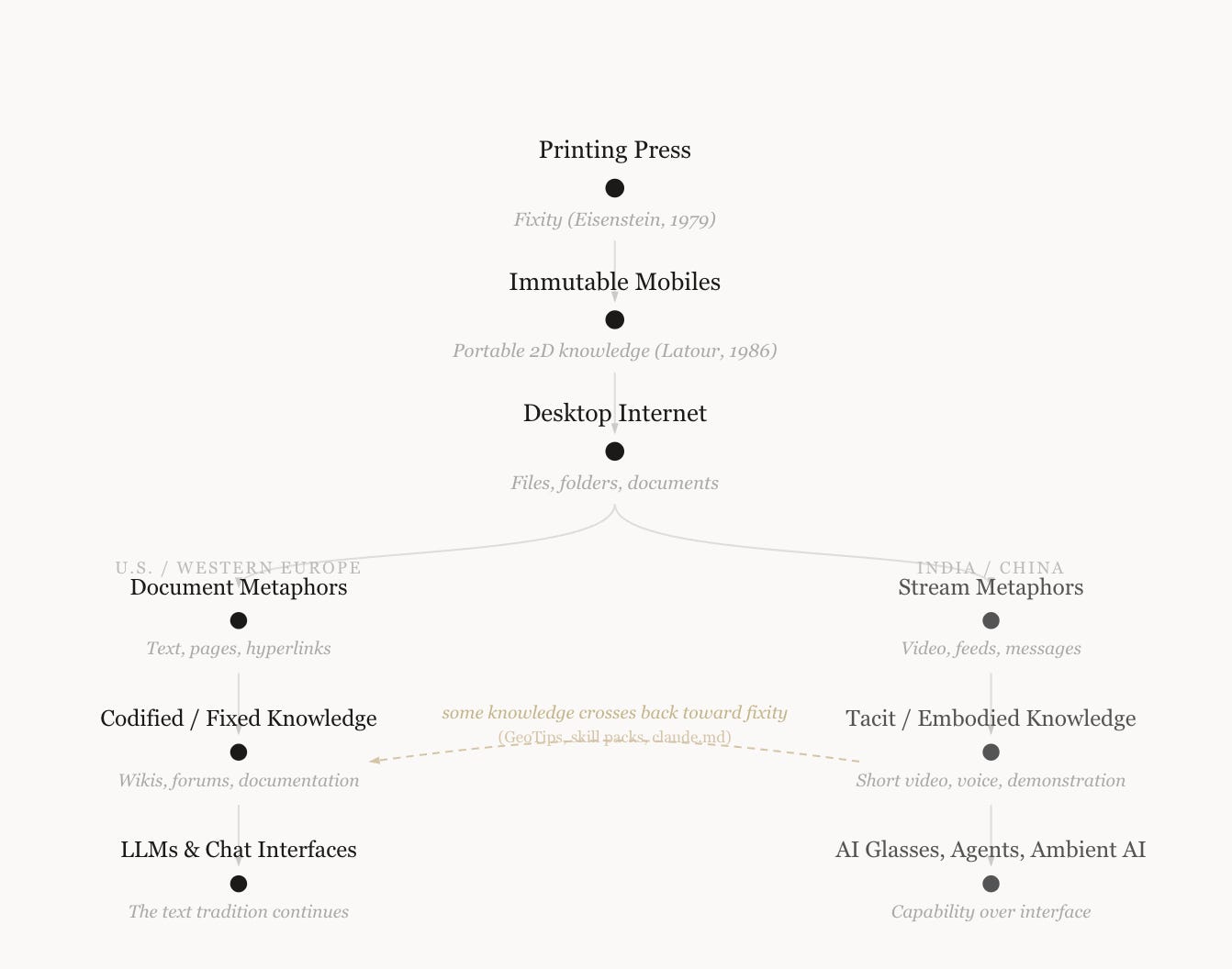
Most of the explicit, codified knowledge of our time has its origins in the printing press, which introduced the mechanism of fixity: the ability to reproduce texts in identical copies at scale, making knowledge stable and cumulative in a way that manuscript culture never could. Before print, every hand-copied text introduced errors, so knowledge tended to degrade over time. With print, a standardized version could be widely distributed and preserved, enabling sciences, maps, and scholarship to build reliably on prior work rather than constantly losing ground to scribal drift.
Writing in 1986, Bruno Latour extended this insight by arguing that printing and fixity created what he called “immutable mobiles,” two-dimensional inscriptions of knowledge that were extremely portable and transmissible. A map, a botanical diagram, an accounting ledger: all could be carried across distances, compared side by side with other inscriptions, and combined to form entirely new fields and terrains of knowledge. A naturalist in Paris could compare drawings of a plant collected in Brazil with specimens described in a Swedish taxonomy, and from that combination produce something new. Most of our concept of knowledge, particularly when it relates to technology, is tied to this two-dimensional immutable plane that Latour describes.
But knowledge produced at the newer abstraction layers, even after professionalization, may not be as fixed as the knowledge at the lower substrates.
Both India and China are regions where most of the population skipped the desktop era of the web and went straight to mobile. The metaphors that shaped the desktop era were document metaphors (files, folders, texts), all of which map neatly onto the two-dimensional immutable plane of print that we were familiar with before. But for someone who first encounters the internet through a mobile phone, the metaphors they become familiar with are stream metaphors: videos, timelines, messages, feeds. They skipped the desktop metaphors entirely, and as a result, there is less attachment to fixed versions of knowledge and more affinity for tacit, embodied knowledge that flows through short videos, voice messages, and live demonstrations.
This could explain why AI enthusiasm in China is not limited to large language models and chat interfaces, the form factor that most directly mirrors the print-and-text tradition. In China, AI is showing up in forms that are much more embodied and ambient. At tech exhibitions across the country, AI glasses stands have become some of the busiest spots on the floor, with ordinary consumers lining up to try on devices from Baidu, Alibaba, Xiaomi, and Rokid. These glasses let you pay in shops with a glance at a QR code and a voice command, translate conversations in real time with subtitles rolling across the inner lens, or snap a picture of a product and instantly price it on Taobao. Chinese smart glasses shipments grew over 100% year-on-year in 2025, and the country has rapidly become the fastest-growing market for the devices globally. At the same time, there are viral videos of normal people, not developers, queuing up to install Claude Code on their devices, eager to start building things with agents. The enthusiasm is not for the text; it is for the capability. The interface matters less than the action it enables.


The question is: what happens to the lower substrate of knowledge that these higher levels of abstraction are based on? Who maintains the infrastructure of maps for GeoGuessrs if no one has embodied spatial knowledge anymore? Who manages the development of programming languages or the open source protocols that govern the web if the new generation of builders only operates at the agent layer?
The lower substrates of knowledge get maintained when, at the higher abstraction layers, there is a culture of error correction or a dedication to the scientific principle of going back to verify and refine what lies beneath. Photography is a useful example of this. When cameras first automated exposure and focus, there was reason to worry that the underlying craft knowledge (understanding aperture, shutter speed, depth of field, the behavior of light on film) would atrophy. And for the average snapshot, it did. Most people today take photographs without any understanding of what is happening inside the camera. But at the professional and enthusiast level, the lower abstraction layer not only survived, it flourished. Photographers still shoot in manual mode, still manipulate individual elements of exposure and composition, and argue about the qualities of different lenses and sensor sizes. What happened was a bifurcation: at the higher abstraction layer, the focus shifted from the specificity of the image to the art of storytelling through editing, sequencing, and post-production. At the lower layer, a dedicated community preserved and continued to develop the foundational craft. The two layers coexist, and the health of the higher one depends, at least in part, on the continued vitality of the lower.
But not all knowledge survives in this way. Some types of knowledge will not endure either in fixed or embodied forms. The most famous example is Roman concrete. The Romans developed a technique for manufacturing concrete that produced structures of extraordinary durability (the Pantheon, aqueducts, harbor seawalls), many of which are still standing two thousand years later. Modern concrete, by contrast, begins to deteriorate within decades. For centuries, the Roman recipe was completely lost. It was only in recent years that researchers at MIT and Harvard discovered the secret: the Romans used quicklime in a hot-mixing process that created tiny calcium deposits called lime clasts throughout the material. These lime clasts, long dismissed as evidence of sloppy mixing, turned out to give the concrete self-healing properties. When cracks formed and water seeped in, the calcium would dissolve and recrystallize, filling the crack and restoring the structure’s integrity. The knowledge existed as embodied craft, passed down through generations of Roman builders. It was partially documented in the writings of Vitruvius and Pliny the Elder. But neither the embodied practice nor the fixed texts were sufficient to preserve it through the centuries of disruption that followed the fall of Rome. It took modern material science, working backward from surviving structures, to reverse-engineer what Roman builders once knew in their hands. Not all substrates get lucky. For every Roman concrete that gets rediscovered, there are countless techniques, practices, and ways of knowing that simply disappear, neither fixed enough to survive in text nor embodied enough to survive the interruption of a tradition.
It is worth noting that both photography and geoguessrs (where there is bifurcation but both lower and higher layers survive), are fields where the number of people with specialized knowledge is way fewer compared to people taking photos or using maps without thinking twice about it. With AI, we are likely to see more fields follow this path of new skills being built at the recognition layer, with a dedicated layer of contributors (both human and AI) maintaining the production layer.
Wow great read