
LLMs Pre-Commodify Ideas
Everyone's having the same epiphanies and chasing the same alphas
One of the historical anecdotes I often think about (intrusively on a Friday afternoon) is how Oklahoma City was established in a literal Land Run. Since the land that the city is on was unallotted, potential settlers were asked to be at the border of the unallotted space at noon on April 22, 1889. Then soldiers fired cannons at roughly noon (not everyone had a clock or a watch) and people raced in on foot and on horseback to hammer stakes onto plots and divide the land among themselves. But not everyone followed the rules. There was a group of people who, having heard of the land run, hid out in ditches and trees overnight. When the cannons went off, these were the guys who were the fastest to claim the best pieces of property. They came to be called the Sooners, because they front-ran the gun. The University of Oklahoma sports teams are still referred to as the Sooners. The settlers who claimed to be legal entrants came to be called Boomers. We are currently seeing the emergence of a new era of Boomers vs Sooners. This time in conquering and striating ideas rather than land.
A couple of weeks ago, rafa from Protocol Institute sent me a paper called From Shafts to Wires, by Warren Devine. In it Devine argues that although factories switched to electric power in the late 1890s, it took a full 40 years to see the productivity gains from electricity because for a long time factories had just swapped out the steam engine for the electric motor. The productivity gains eventually came from re-designing the entire factory floor with electric motors powering each machine individually instead of a central shaft powering the entire factory. At that point, it felt like we had found a great analogy for what was going on with AI deployment. We added this to our working document and moved on. A couple of days later, I noticed that other people had been talking about the same Warren Devine paper, and making the same analogy. All of whom had presumably got this idea from interacting with an LLM (just like me and Rafa).
I’ve noted numerous instances of this happening1 in the last few months and I don’t think it’s coincidence or simply faster diffusion of ideas. Everyone working in the same latent space of a problem (using LLMs) arrives at similar ideas, independent of each other, almost simultaneously. Whereas earlier, new ideas would have enjoyed some alpha that could be capitalized on, and they could be tracked to an originator. I associate legibility with Venkatesh Rao , everything is securities fraud with Matt Levine, and zero interest rate personality with Drew Austin . But now, new ideas arrive pre-commodified, ready to be distributed, lacking clear attribution or common knowledge among the people who discover it.
Why does this happen? An LLM’s training corpus is diachronic, that is, it was accumulated across time, carrying years of training data, shifting facts and evolving styles. The model itself, however, is a synchronic compression. All the temporal depth of the training data is collapsed into a latent space of relationships existing at a particular moment. Retrieval Augmented Generation (RAG) bots add an element of diachrony to synchronic LLM interaction, where the synchronic LLM is combined with ideas from the present. When we use LLMs we are pulling ideas from the past and re-combining them in a newer, more present context. As multiple people work on the same latent space of problems, we pull forward the same sticky ideas along the same gradients in the latent space, ending with roughly the same ideas.
Everyone arrives at new ideas independently, trying to stake a claim on a slippy terrain. Since most of these ideas are arrived at through solipsistic adventures in thinking, no common knowledge develops. Everyone knows the idea but no one knows that the other people also know. So now you have multiple people trying to capitalize on the alpha they think they have without the knowledge that the alpha had arrived in commodified form.
Joel Spolsky, in Commoditize Your Complement, observes that every product has complements, things consumed alongside it. Hardware needs software and cars need gas. The demand for your product rises when the price of its complements falls. So smart companies work to drive the price of their complements toward zero. In Spolsky’s canonical example, Microsoft commoditized PC hardware so that the scarce, profitable layer was the operating system; IBM later backed open-source software to commoditize the code and sell the consulting and hardware around it. The strategy is always to make the adjacent layer abundant and cheap so that your layer is where the scarcity, and therefore the margin, lives.
What are the complements of ideas? One is distribution. If ideas are commoditized then distribution becomes important once again. But the marginal cost associated with distribution went down to near zero during the web 2.0 era. Distribution is economically cheap and fast.
So in an era where both distribution and ideation are commoditized, the valuable complement becomes establishing provenance. Whoever is able to establish a claim that they originally came to an idea wins. This can be done in two ways. The first, the Boomer method, would be producing quality ideas consistently over a long period of time, writing about the same ideas over and over again. In some ways this would resemble content in the early years of Google search, where SEO favored people who had consistently explored a topic. The second, the Sooner method, would be front-running ideas before an LLM model gets released and then profiting off the proliferation of those ideas after model release. If you want the stock of SpaceX to go up 6 months from now, you could over-index training data on SpaceX, its suppliers, and the bull case for SpaceX vs being strategic about the bear case for SpaceX, then release a new version of Grok a couple of months earlier and then make people believe that they came to the idea by “doing their own research”. The next generation of “everything is securities fraud” will be models being pre-trained on the theses that they are supposed to be traded on post-release.
The new attack vector for propaganda would be poisoning data used to train the LLMs, and hence this will also be the next battleground for the ongoing, never-ending culture wars.
Prediction markets will get trained on the sticky gradients in the latent space of new LLM models and then update their beliefs accordingly.
Advertising, the industry worth hundreds of billions of dollars, is also not going away. In fact, the pre-commodification of ideas solves a decades-old problem that advertising has had, which is making the desire to buy something seem as natural as possible.
The liveness of the world diminishes when everything comes pre-configured. There will be no true carnival time, because everyone will be attuned to the time set by LLM model releases. One of the functions of being early to an idea is that you get to make mistakes and refine the idea before it reaches commodity status. In the absence of this, our environment will be full of jagged ideas that don’t quite fit into the environment. Ideas will affect the environment at scale before they are ready to be deployed at that scale.
The blocks of Oklahoma City are oddly shaped with weird asymmetric boundaries, an aesthetic and functional remnant of various factions of land grabbers battling it out in 1889. Our idea spaces are also poised to become similarly jagged terrains.
Thanks to Venkatesh Rao, rafa and Protocol Institute for brief alpha on this one
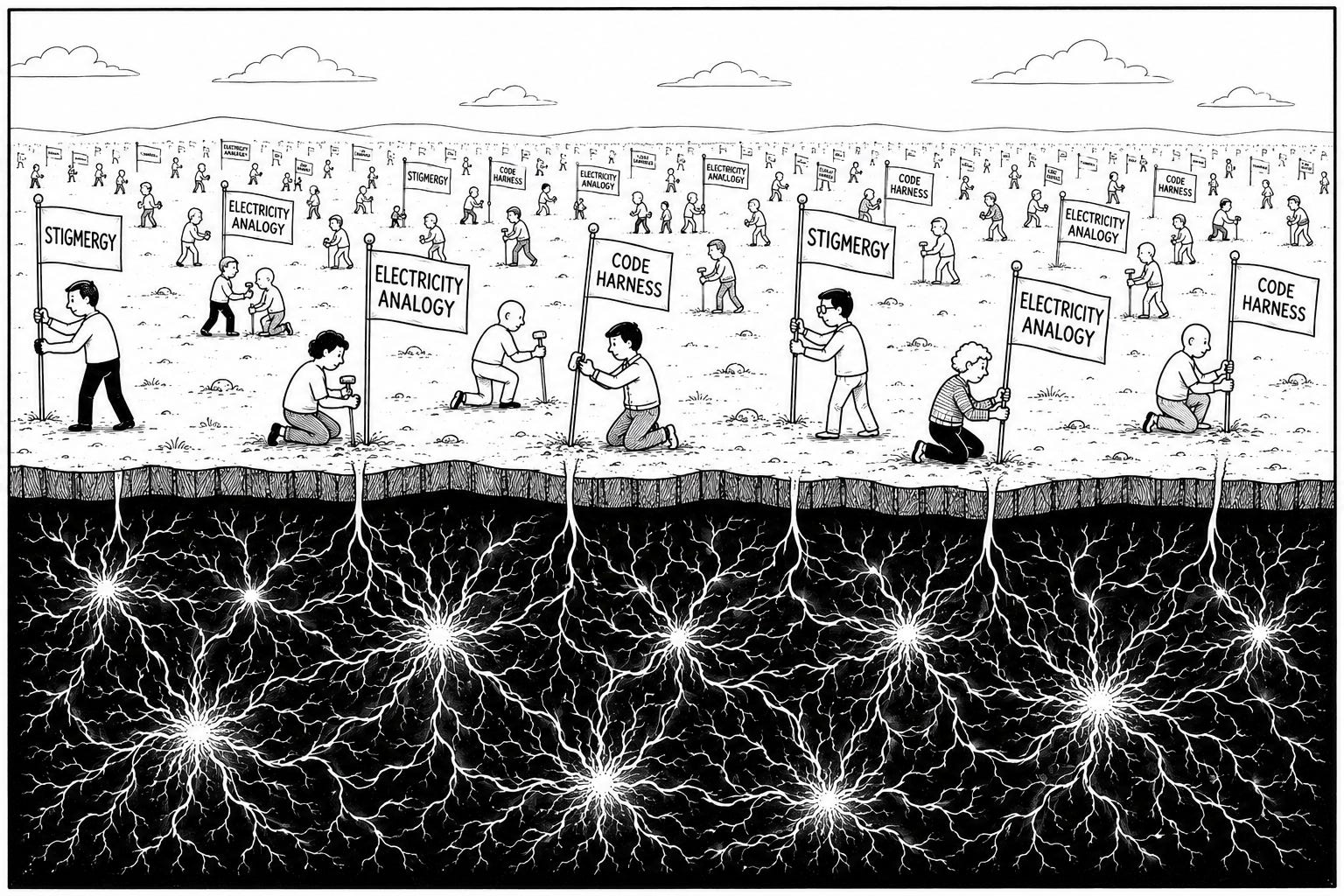
Another topic that went through a similar trajectory is Stigmergy. There are a few papers on the topic of stigmergy, but suddenly one day it was just everywhere. When I asked someone who wrote an excellent piece about AI and work using the stigmergy analogy where they got the idea from, he mentioned he got it from AI.
Feels like an updated version of “If you read what everyone else is reading, you will think what everyone else is thinking” (Murakami)
Another way to fight it is to read widely based on your own interests.
Nice synthesis!
It made me think of LLM's as an instrument and the music we make with them as another analogy with similar meanings.
We are all playing the same instrument (more or less), we bring our context to tuning the ideas it produces, but the instrument only has so many notes. Not surprising we play similar tunes.
I like this because music demonstrates the rich generative potential of combinatorial composition, especially when in harmony with collaborators.
It also tells us it would be great if we could design some alternative instruments, attuned to and trained on different frequencies and bodies of knowledge.
Great fact about Oklahoma lol!