
Metabolizing Monsters
Online swarms and social web as unprocessed monsters
This is the sixth installment in a series on Archival Time, where I investigate the new cultural temporality introduced by LLMs.
Previously, In Archival Time, I wrote about the carnivalesque nature of internet vs archival slice nature of LLMs. You can find the rest of the posts in this series here
Carnival Monster. Bakhtin once wrote that the medieval carnival had the power to neutralize monsters not by eradicating them but by immersing them in collective festivity. The grotesque body, the giant, the demon—these figures lost their terror when set inside a temporary world of inversion and laughter. Carnival metabolized monsters by containing them in ritual time: terror dissolved in the crowd’s joy, but only because the feast was bounded. There was an outside of carnival to return to.
Our problem is that the carnival never ends anymore. The marketplace is always open, the timeline always churning, the inversion never resolving. Carnival without limits becomes its own kind of monster. Joy unbound bends into anxiety. The grotesque, once a release, overwhelms when it becomes the default condition. What once neutralized monsters now produces them.
Monster culture. Jeffrey Jerome Cohen’s seven theses on monsters is useful here. Monsters appear, he writes, when a culture cannot articulate its anxieties directly. They are symptoms of a moment—“embodiments of a time, a feeling, and a place”—and they emerge precisely at the sites where categories fail or pressures cannot be spoken.
The monster is culture’s externalization of its own unprocessed material. It embodies fear by giving it a body; it reveals what the culture cannot yet face.
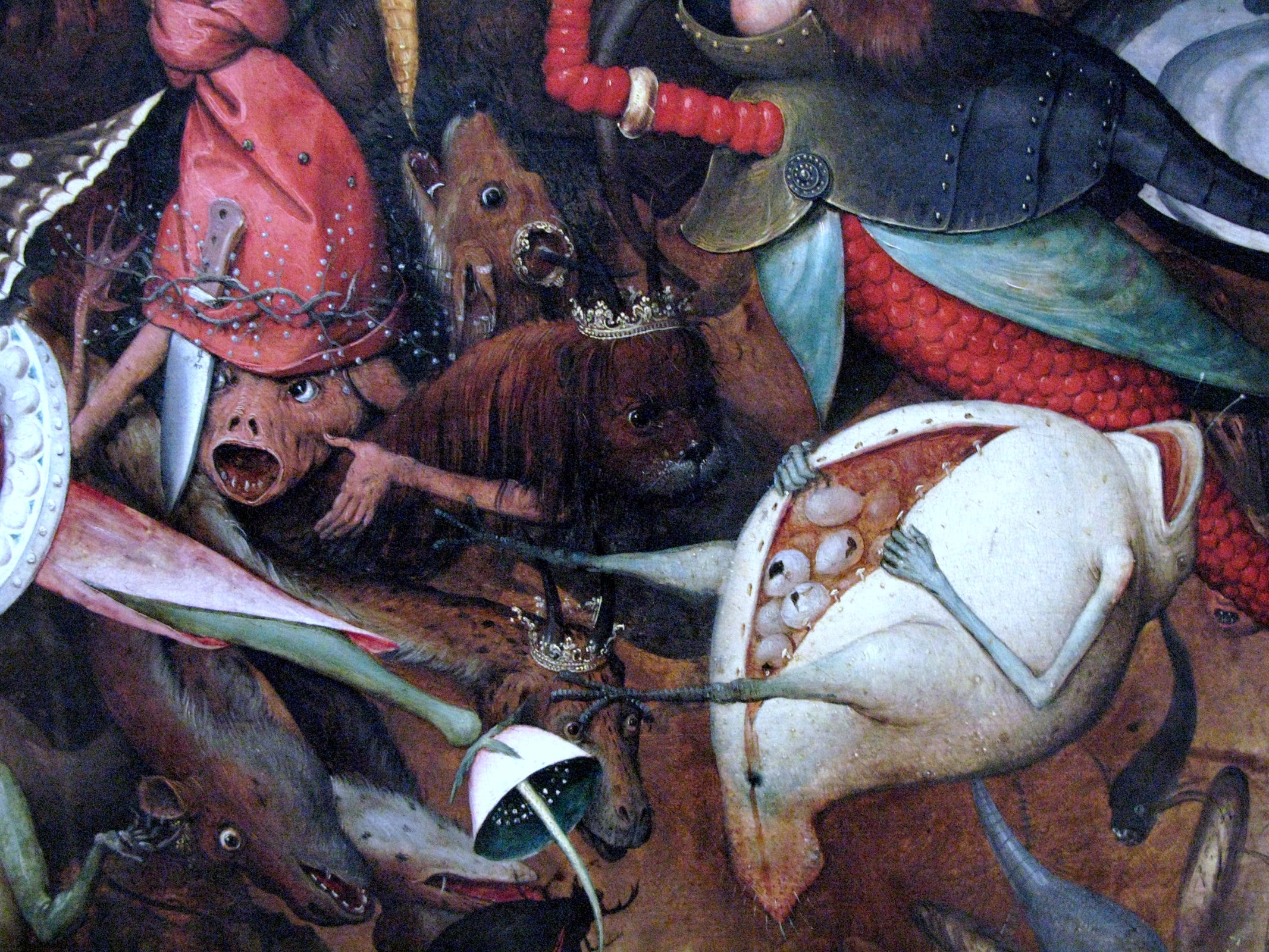
Monster becomes Merch. But Cohen also tells us that once the monster has done its work—once the cultural tension it embodied is understood, transformed, or made manageable—the monster is neutralized. It becomes decorative. Metabolized. Incorporated.
You can watch this working itself out in the genealogy of the vampire. Early vampire folklore in Eastern Europe grew from real anxieties about petty nobles and landlords who extracted life from the villages they ruled. These vampires were monsters of political economy—creatures of extraction. Bram Stoker retains that aristocratic shadow in Dracula but transforms it: the horror becomes erotic, intimate, a charged transgression. The bite is frightening because it entangles predation with desire. From there the vampire grows steadily safer—Interview with the Vampire turns it into a goth icon; Twilight and the romantasy boom make it a romantic ideal. What was once feared becomes merch. The monster is metabolized.
Swarms. But the monsters that trouble us now are not like vampires. They are not characters at all. They are crowd-forms.
Rafael Fernández, in Welcome to the Swarm, describes how online collectives operate not as communities or subcultures but as emergent, minimally protocolized systems moving through whatever smooth space they can find inside the increasingly striated corridors of platform design. Platforms try to impose order—moderation heuristics, safety rails, recommendation ladders, identity gates—but swarms slip into the gaps. They coordinate without collective identity. They accelerate and dissipate like weather. Their power comes from their formlessness.
This is why it feels wrong to label betting culture, crypto-degen behavior, and gooner forums as subcultures. A subculture is a culture—a body of practice that reproduces itself. These formations do not reproduce; they propagate. They do not build institutions; they move through infrastructures. They are not communities; they are currents. They do not care who participates; they care that participation produces amplification.
What they resemble, more than anything, is the monster Cohen describes—the monster as “harbinger of category crisis”, appearing precisely when the boundaries of identity, agency, and social coherence begin to fail.
Like monsters, these crowds emerge when the culture cannot articulate the pressures acting on individuals. We invent names—degens, gooners, swifties—not to describe them but to manage our own discomfort. We call them subcultures because “crowd” feels too unbounded, too honest about what is actually happening.
Multiplicity. But unlike vampires or witches, these monsters cannot be easily folded into narrative or symbol. They cannot be domesticated by genre because they have no singular figure to represent them. They are pure multiplicity. The best we can do is anthropomorphize their effects: NPC memes, endless sub-cultural analysis the fear that everyone else has merged into a hive of unthinking behavioral scripts. These are attempts to narrate a monster that refuses to appear as an individual. It is the many-as-one, the one-as-many.
Historically, societies have never defeated swarm-monsters by suppressing them. They metabolize them through infrastructure & Protocol.
Among the Thugs. English football hooliganism in the 1980s was a pure swarm: dense, loud, unpredictably violent. The state tried policing—riot police, fences, mass arrests—but policing increased volatility because it treated individuals as the locus of behavior. The crowd-form persisted. What changed everything was stadium architecture: all-seater designs, predictable ingress and exit flows, sightlines that reduced blind spots, environmental constraints that lowered variance. The swarm was not punished; it was metabolized. Surprise collapsed by redesigning the substrate.
Haussmann did the same for Paris. The medieval street plan made insurgent crowds tactically unpredictable. The new boulevards metabolized the crowd by reducing its degrees of freedom. The monster dissolved not through moral reform but through spatial reconfiguration.
What makes our present moment unusual is that the monster is now symbolic, not spatial. The swarm lives in discourse, in affective cascades, in memetic drift. And the metabolizer that has emerged is not architectural but statistical: the large language model.
LLMs absorb the linguistic output of crowds and compress its variance. They smooth the jaggedness of discourse storms, turn memetic chaos into coherent surfaces, and produce predictable continuations where once there were shocks. They metabolize not bodies, not streets, but patterns. They are non-punitive, and non-coercive. LLMs are symbolic Haussmannization: boulevards made of probability distributions.
Inference. To understand why this entire process feels uncanny—why the shift from swarm to metabolizer, from carnival to archive, carries a sense of estrangement—Active Inference gives us the deeper physiological and cognitive mechanism. At its core, Active Inference proposes that organisms survive by minimizing surprise. Everything alive engages in a continuous dance between two strategies: updating internal models (attunement) or altering the external world (metabolization).
Attunement is the romantic strategy. It is curiosity, sensitivity, openness—what Bakhtin would call the expanded body, reaching out toward novelty. Updating internal models keeps the organism in dynamic contact with the world; it is how we learn, adapt, improvise. But attunement is metabolically expensive. It requires attention, and attention is a scarce resource. The organism must hold uncertainty long enough to integrate it, must tolerate prediction error without flinching, must remain permeable to signals that may contradict its priors. There is a reason curiosity is exhilarating but exhausting.
Endless carnival—endless swarm—short-circuits this balance. The swarm produces too much signal for attunement to manage. It demands constant belief-updating, constant vigilance, constant micro-adjustments in posture and expectation. The carnival without intervals becomes a form of cognitive weathering. The organism tries to attend, but the signals multiply faster than the capacity to interpret them. Prediction error accumulates like unprocessed static. The system doesn’t have time to learn from surprise—it can only brace.
And this is the pivotal point: when attunement can no longer metabolize surprise internally, desire collapses into need. Desire is expansive; it flourishes when the organism can afford openness. Need is contractive; it emerges when the organism is forced into defensive prediction, when it must narrow its world to survive. Eventually need tips into overwhelm. The organism cannot update its beliefs fast enough, cannot close the loop of error correction, and begins to seek safety through withdrawal, avoidance, numbness.
Active Inference predicts this collapse elegantly: when the cost of internal updating becomes greater than the cost of altering the world, an organism—or a civilization—will begin shifting its metabolic work outward. It will build structures, rituals, architectures, interfaces, or technologies that externalize the labor of making the world predictable again. And in a media environment defined by swarm behavior and permanent carnival temporality, that shift becomes not just likely but necessary. The cognitive load must be displaced somewhere, or the system breaks.
LLMs enter precisely at this threshold—as externalized organs for smoothing surprise.
Lost time. But the risk of smoothing surprise is subtler than it first appears. Surprise is not merely a cognitive event; it is one of the ways organisms feel time. The spike of the unexpected, the rupture in expectation, is what gives temporal experience its contours. Without surprise, time becomes undifferentiated—less like a sequence of moments and more like an inert medium we drift through.
When a system externalizes its prediction-error minimization—when the work of absorbing volatility is handled by an environment or a model rather than the organism—time begins to flatten. The roughness that made moments memorable is ironed out. The small shocks that once served as temporal markers are absorbed before they reach consciousness. The carnival becomes muted, not because chaos has disappeared, but because it has been pre-processed.
This is the double edge of any metabolizing system. Haussmann’s boulevards made Paris governable, but they also made it predictable; the old city’s temporal irregularities— spatial anachronisms, its cramped pockets of history—were smoothed into a uniform urban rhythm. The modern stadium tamed hooliganism, but it also tamed the temporality of the match day, converting an unpredictable social ritual into a choreographed spectacle. These interventions reduce danger but also reduce temporal nuance.
LLMs operate with the same logic, but at the level of representation. When they metabolize the swarm’s volatility into statistical coherence, they produce a discourse that feels frictionless. But frictionlessness has a temporal cost. The sense of “when” something happened—the grain of its moment, the time-stamp in its texture—fades. Outputs blend. Era collapses into genre; genre collapses into pattern. Novelty becomes a variation rather than an event.
Surfaces. This is why interacting with a model can evoke a strange temporal dislocation: it feels contemporary but untethered, fluent but floating. Not wrong, exactly—just time-smooth. The model produces surfaces, not moments. It gives us language without the lived unevenness that originally produced it.
Smoothing surprise gives relief, but at the cost of losing the temporal cues that once anchored experience. If an endless carnival overwhelms us, endless smoothness anesthetizes us. In both cases, the organism loses touch with the rhythms that once made the world legible.
This is the civilizational tradeoff emerging now: the crowd-monster becomes manageable, but time becomes harder to feel.
Ooooh very nice. Lots of insights and gems here... Have you been gramsci gap pilled by vgr?
this is excellent!