
Phreaks, Packets and Prompts
Introducing kit time, the brief moments of unstructured space and time where technology gets interpreted and changed
I often drive my girlfriend to work, and more often than not I’m not really aware of the act of driving until I reach the busy cross street where I have to make a left. I’m so used to driving that I don’t really even pay attention to the act itself. Contrast this with the first time I was driving in India at 18: I was white-knuckling the steering wheel and painfully paying attention to everything around me. It helps that I’m not driving a stick shift anymore, and that the protocols around traffic are much more stable in the United States. I’m able to delegate my attention to the technology (ABS, power steering, autoshift) and to the traffic protocols that I’ve come to trust. As a result, driving is a completely unsurprising activity most of the time, and any surprises that I encounter tend to be bad surprises. If I were to make a montage or comic of myself driving every day, it would not be of interest at all unless I got into a fender bender of some kind.
Now, once again, contrast this with the experience of someone driving a Model T in 1914. First of all, there is no standardized, socially agreed way of driving a car. You could drive people around in it, but the roads are not made for cars and there are no traffic rules. You could haul things in a trailer hooked to the car, or maybe replace the wheels with skis in the winter. The best way to interpret your car at that time is as a portable source of power for personal use. It’s your thermodynamic muscle. The most efficient way of utilizing the car then might be to use it as a fixed power source. Plenty of people bought kits to transform their Model Ts into power sources on farms, powering everything from washing machines to ploughs and churning butter. I wrote about kit-making cultures in more detail here.
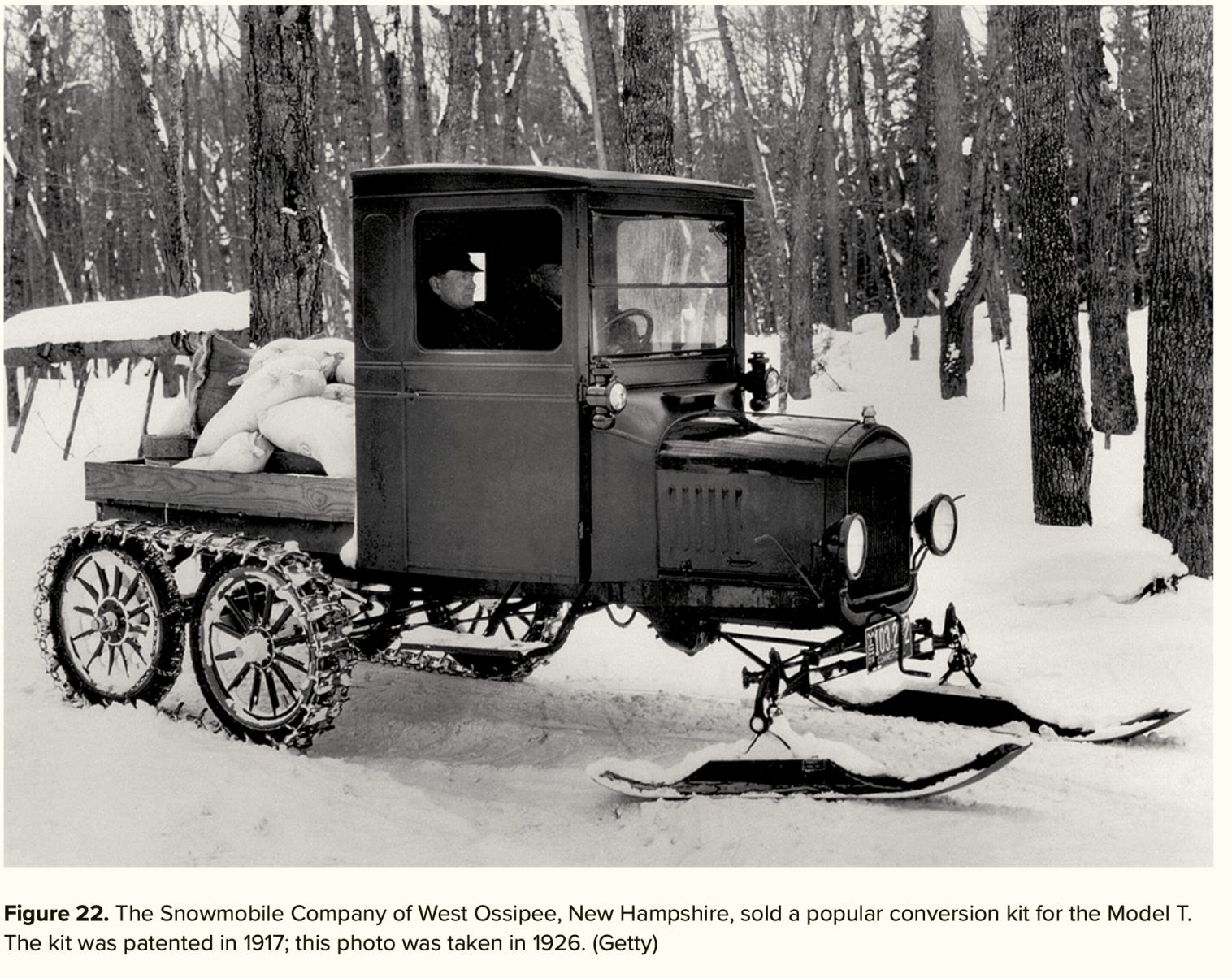
Even though the action was called driving, it looks completely alien compared to 2026. The Model T is not really a car, compared to its modern counterpart. Contemporary cars are so hardwired for day-to-day transport of people and things that using them in any other form makes for good theater, like parades or monster car festivals. The car as a technology is not open to interpretation by its owner anymore, other than in specific subcultures such as modding or amateur racing.
KIT TIME
In Understanding Comics, Scott McCloud writes about how the idea of closure works within comic panels. Comic panels fracture time and space, offering a series of unconnected moments that our mind connects together using our innate sense of completing reality. The closure happens in the gutter between two comic panels. The gutter is where the reader’s imagination comes into play to complete what has been transfigured between two comic panels.
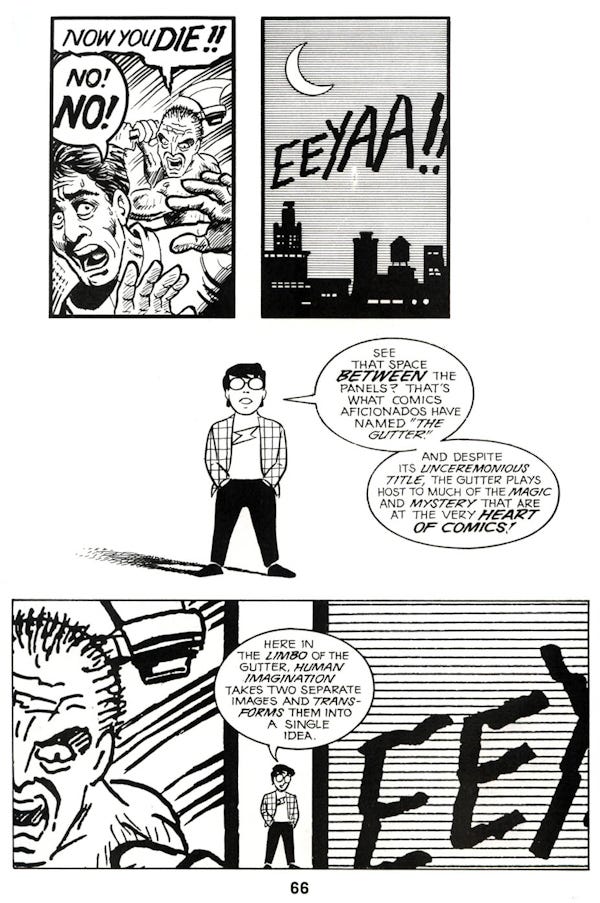
Technological epochs also have such gutters, moments of unstructured space and time where amateurs can interpret a new technology in their own context. This is what I call Kit Time, named after the amateur culture of kit making and experimentation that seems to dominate this phase of interpretative frenzy. During the early years of the Model T, there was a vibrant economy around kits to transform vehicles into a power source for the farm, or a truck to haul equipment. During the Great Depression, families were encouraged to plough to the fence using plough attachments on their cars.
This is not isolated to cars, of course. Many technologies go through this form of closure, where their interpretative flexibility narrows as they mature. The early years of radio broadcasting were sustained entirely by amateurs who saw radio as a replacement for the telephone. Between 1905 and 1912, several wireless radio companies went belly up, and the industry was only sustained by the amateurs who were scavenging, stealing, and repurposing what was around them into radio equipment. In Inventing American Broadcasting, Susan Douglas writes about how public telephones started disappearing because people were stealing the receivers to use as receivers for their amateur radios.
But, by 1912, the airwaves had become extremely saturated with noise (literally). The turning point for radio came that year during the Titanic disaster, when radio played an important role in rescuing people from the capsized ship. Regulators and the navy started taking radio seriously, which eventually led to regulation of the airwaves, with different spectrums being allocated to different uses: navy, broadcast, and the amateurs getting relegated to short-bandwidth radio. Thus the radio underwent closure.
MAKING KIT TIME GO BRRR
The academic interpretation of closure as it relates to technology is that it is something that happens once there are strong structural forces in the form of institutions and companies that shape how the technology is manufactured and distributed. In the case of cars, the argument is that manufacturers clamped down on interpretative flexibility by banning kits and modifications. For radio, academics argue that amateur radio would have continued to thrive if the government had not intervened to regulate the spectrum. There is some truth to this, but it is far from the complete picture.
Phreaking offers a more layered example of how closure works. In the early days of telephony, closure was performed by humans in the loop. When you picked up the phone, an operator would ask whom you wanted to reach and physically patch your line into theirs at a switchboard. The operator was the interpretive layer, deciding how to route your call and mediating the technology on your behalf. By the middle of the twentieth century, this human interpretation had been replaced by automatic electromechanical switching. Bell System engineers used in-band signaling, where the same channel that carried your voice also carried control tones that told the network what to do. A 2600 Hz tone, for instance, told the system that a trunk line was free.
This worked until people re-interpreted it. Joe Engressia, a blind seven-year-old, discovered that he could whistle the right pitch into a receiver and seize control of the line. Years later, John Draper realized that the toy whistle which came in boxes of Cap’n Crunch cereal produced a perfect 2600 Hz tone. Hobbyists built “blue boxes” that could generate the full suite of control tones, and a small subculture of phone phreaks emerged, exploring the topology of the telephone network the way amateur radio operators had explored the spectrum half a century earlier. Steve Wozniak and Steve Jobs sold blue boxes door to door in college dorms before they founded Apple. For a brief moment, the phone system had been dragged back into kit time.
The phone companies responded by moving the control signals out of band. In Signaling System 7, the tones that told the network what to do traveled on a separate channel that the user could not access, no matter what frequencies they generated into the handset. Eventually, the entire system went digital, and the question of how to interpret the network stopped being a question at all. So phone lines went from being closed to interpretation by human operators, to being opened by humans hijacking automated interpreters, to being closed again by out-of-band signaling and eventually digital signaling. Digital signaling is a form of automatic closure, where there is no one in the loop to perform the closure because the mechanism that used to invite interpretation has receded out of reach. Sometimes this is a necessary phase of a technology, but the gutter between the panels disappears, and with it the chance for anyone to read the technology differently than its makers intended.
The mature phase of a technology is the transition from comic panels to animated movies. Suddenly, closure is not something that happens within the mind of the reader, but something that happens automatically, within the technology, at 24 frames per second, i.e., 24 closures per second.
Closure is something we engineer because reality is too complex to pay attention to in whole, and closure then is also something that happens in our artificial environments. It’s a property of technology just like natural selection is a property of all living things. Technologies tend toward closure, the way natural selection tends toward fitness.
When automatic closure happens within the context of technology, it fades into the background and becomes part of the environment. Technology becomes something we delegate our interpretation to, as we attend to other parts of reality that are now open to us.
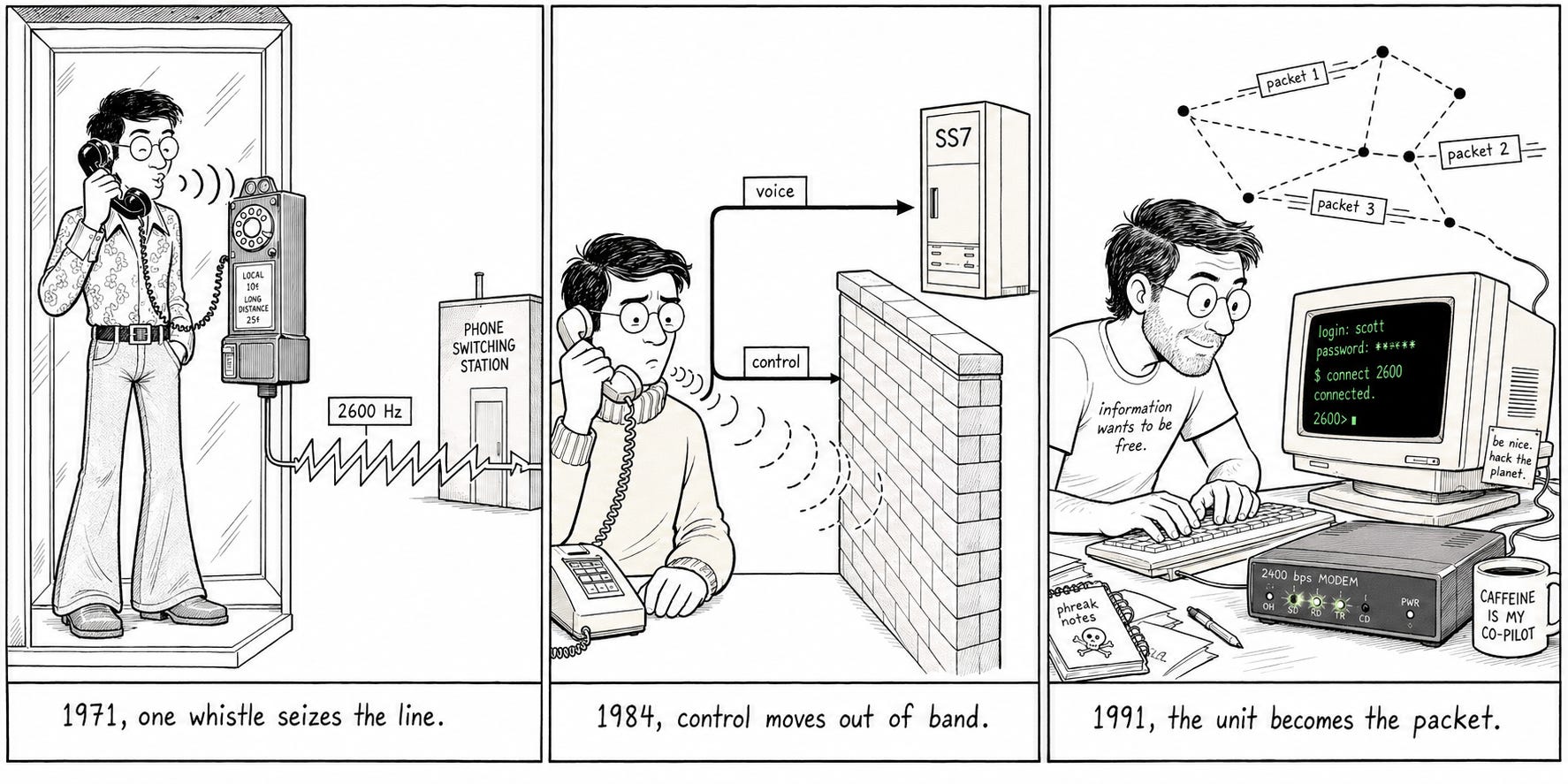
The interpretative, kit time tendency moves to the new gutter. For example, in the case of phreaking, many of the same people turned their focus away from phones (which used circuit switching at the time) to packet switching. In the phone network, the network itself knew about your call. It set it up, maintained and billed for it, and was the only thing capable of interpreting what was happening. In a packet-switched network, the network is deliberately dumb. It just forwards packets. All the interpretation happens at the endpoints, where the computers at either end decide what the packets mean, whether they are an email or a web page or a video call or a file transfer. This meant that people could seize control of a node in a packet switched network and do weird things. In 1981, Ian Murphy, who hacked under the handle Captain Zap, broke into AT&T’s billing systems and inverted the internal clocks, so that customers were charged cheap night rates during the day and expensive day rates in the middle of the night. He was the first person convicted of computer crime in the United States.
ATOMS OF INTERPRETATION
The first time you learn to look at a clock, there is a lag. Then suddenly you are acutely aware of time to the second, and eventually the awareness itself becomes subconscious. If you take it further, everyone now follows the same clock. It used to be that clocks would run slow over time because they were made with quartz, but now all our digital devices run on the atomic clock. The technology moves from a tool to structure the day that you have to learn to something subconscious to a complete environment. Kit time is built on top of such stable environments. Phreaks could play with the phone network because electricity and copper wiring had already become nature. The kit timers of the 1980s could play with packet networks because the phone network had become nature.
An interesting pattern in the interpretation of technology is that the interpretive unit gets smaller and smaller over time. With phones and phreaks, the unit is the phone line connecting two endpoints. With packet networks, you are dealing with packets of information that arrive jumbled and can only be reassembled at the receiver. If you extend this to LLMs, you are interpreting at a layer below packets, at the level of tokens.
You could say the same of mechanical goods. In the example of cars, you were dealing with a machine that was assembled at the factory. It required some finesse and skill to modify it to accommodate your context. Modern drone manufacturing offers the opposite example. China controlled 80% of the market for small drones at one point, up until the Ukraine war. Now, Ukraine has repurposed factories to make its own drones, but this is obviously hard to do from scratch. So Ukraine now imports drone parts from China through intermediaries and shell companies, so that the supply chain cannot be traced, and builds some of the critical components on its own.
Perhaps this tokenization of interpretation is what makes it harder to analyze modern kit time. The gutter space exists at the token level that is invisible to the naked eye, and to see this we need new types of augmented vision to investigate our new nature.
Thanks to my friends at Protocol Institute for conversations that helped this piece come together
Lovely piece!
Makes me wonder if all technologies tend towards closure and if they have to.
To me, there is something beautiful about expanding or at least keeping open the gutters of interpretation. It leaves technology open to possibility. Rather than collapsing to the one way a technology must be used/interpreted. I recognize there is only so much complexity one has the capacity to attend to, but we could focus on increasing this capacity instead of constraining the complexity and delegating interpretation to technology.
What might societies look like that encouraged creative interpretation of its technologies I wonder.