
Robot Vaudeville
Something human encrusted in the mechanical
For about two years after I stopped being active on Twitter, my For You feed was just snuff violence and random acts of racism against Indians. But something flipped in the last year and now the feed is Chinese robots doing exotic dances, fixing cars and American entrepreneurs tweeting about how they fired the measurers and middle managers in their company thanks to AI. The earlier instantiations had some divergence: the Chinese videos displaying physical instances of AI vs Americans promoting the might of general-purpose models and code harnesses. But, in the last six months, the Americans have caught onto the Chinese approach, so now we have people having conversations about putting data centers in space, and attempting to manufacture drugs on space stations.
In one of the videos, a Unitree humanoid robot that has been trained to tighten nuts using a large torque wrench is shown going amok. After tightening a few fixtures on an assembly line, it seems to get exasperated and accidentally gets drawn into the assembly belt, only to be pulled out by a manager. Then, something seems to go wrong. The robot looks around and starts to see nut-shaped objects everywhere in its environment. At first it’s the nose of a factory worker, then his nipples, and then buttons on a woman’s skirt. The robot escapes the factory, approaches a fire hydrant and attempts to apply the wrench to it. Eventually it is chased back inside the factory by someone enforcing the law on robots.
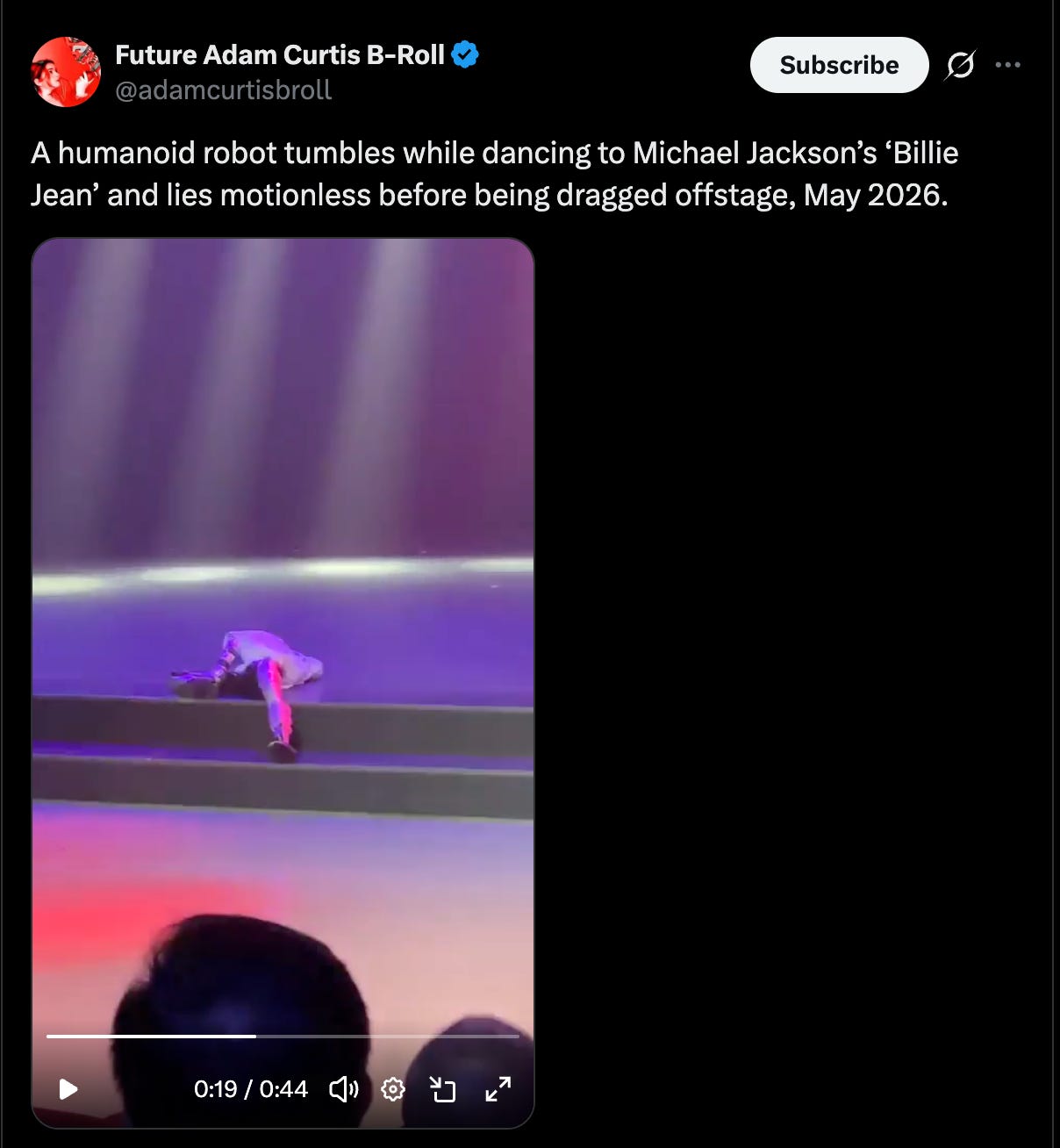
Just kidding. That’s just a setup of a gag in Charlie Chaplin’s Modern Times. Instead of a robot it’s Chaplin playing a man acting like a robot. But, if you squint, the Chaplin bit is not that different from the clip of a robot dancing to Michael Jackson’s rendition of Billie Jean, tripping a few times before laying face down on the steps, lifeless and disgraced.
In an attempt to get more distribution in an era where distribution is broken, AI boosters and doomers have converged on what I’d call a vaudevillian spectacle approach to AI. Robots are either saviors or monsters in these physical spectacles.
Of course, vaudeville itself found a lot of inspiration in the second industrial revolution, which may explain part of the success of such visual spectacles. During the early 1900s, vaudeville acts replaced the previous era of circus centered around cowboys and frontier people. One of the early, popular vaudeville acts was to assemble and re-assemble a Ford Model-T in under 8 mins. By the 1920s, the time for assembling had gone down to 3 mins. There are car enthusiasts who still continue this tradition as part of car fairs around the country.
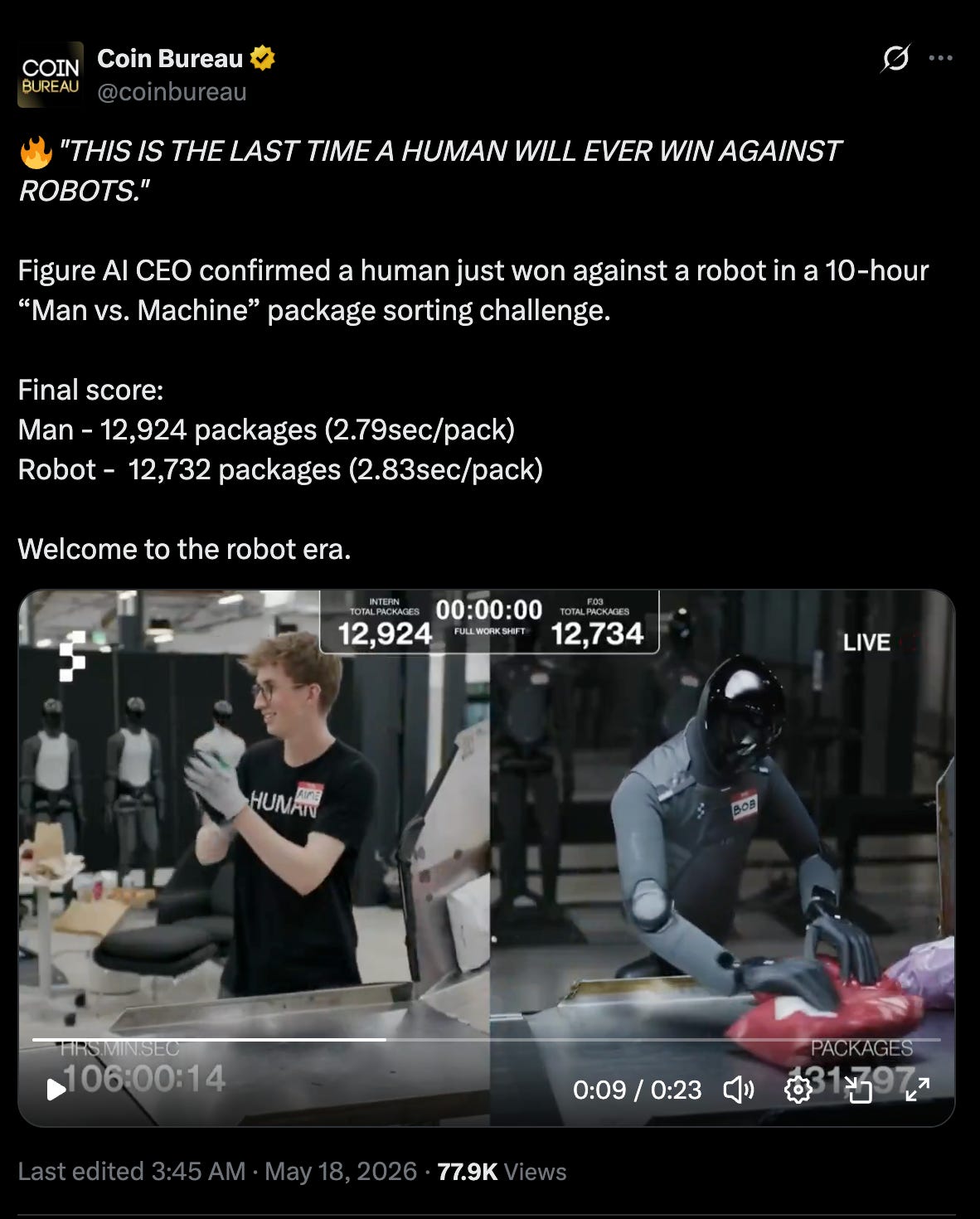
A couple of weeks ago, Figure AI, an AI startup, hosted a livestream where a human competed against a robot in a 10 hour package sorting challenge, which the human eventually won. It looks like a perfect combination of the Model-T vaudeville act with the assembly line bit from Modern Times, except it seemed completely humorless, which seems to be one of the core features of robot vaudeville. Watching clips of the livestream made me feel bad for the human, because he has been reduced to a robot and also for the robot, whose physical might was reduced to sorting packets just like humans do.
This ramping up of physical spectacle, albeit without humor, stirred a desire to watch Charlie Chaplin. Some of the older Chaplin movies were the first I ever watched with my father on our then newly bought VCR. I rewatched Modern Times and Gold Rush. In the former, Chaplin plays an exasperated factory worker who’s incapable of being reduced to a cog in the machine, and ends up having a nervous breakdown when the managers decide to test a machine that force feeds him. The latter is about men searching for gold in the wintery, unexplored mountains of Alaska. If one shows human agency reduced to the agency of the machines around man, the other shows the primal coyote-roadrunner instincts that take over in frontier environments without rules. Both are extremely funny, of course.


Chaplin made Modern Times after a conversation with Mahatma Gandhi, where he could not understand why Gandhi was opposed to automation and machines. His confusion is understandable because vaudeville was one of the original responses to the second industrial revolution that went beyond fanatic opposition and enthusiastic boosterism. The vaudeville approach was to laugh at and create entertaining spectacle out of automation.
But, alas, a lack of humor seems to be the most striking aspect of robot vaudeville. In the 1900s, Henri Bergson theorized that we laugh when we perceive the mechanical encrusted upon the living. The Coyote that chases the roadrunner is mechanically following his impulses over and over again, regardless of the outcomes in which he gets his face blown up. Chaplin’s Tramp in Modern Times is a man who is forced to act mechanically in the environment of the factory. He escapes the environment of the factory only to realize through various comical situations that “acting mechanically” is not limited to the factory environment, but pervades society in its rules and institutions. He proceeds to get caught many times in the encrusted mechanisms of day to day life such as law and order, department stores, and dreams of domestic bliss.
In media with robots, such as Hitchhiker’s Guide to the Galaxy and Futurama, the humor emerges from watching robots act like humans but only to reveal layers of machine-like behavior underneath. They fail at being human in endearing ways. Robot vaudeville is not quite that. It is humanoid robots attempting to act like humans and either failing miserably or succeeding beyond belief. The former is tragic and the latter feels more like a sublime spectacle at a distance.
In an interview from several years ago, Norm Macdonald, when asked about why he didn’t find modern impressions of Donald Trump funny, responded, “When you do an impression, you have to like that person... you can’t play someone and have contempt for them.” There seems to be some truth in this. Charlie Chaplin played Hitler in The Great Dictator but later in his autobiography remarked that he could not have made it as a comedy if he knew the extent of the atrocities that Hitler committed (the movie came out in 1939). Even in satire, you need some element of empathy for the subject you are satirizing. We need to perceive something human in the subject before the mechanical is encrusted upon them. Robot vaudeville does not evoke this in me. Instead I feel a desire to reduce the sublime distance between me and robots so that they become familiar, and part of my natural environment, then maybe one day I’d find them funny.