
Designing Carnival Time
What makes an environment permeable to carnival?
With the World Cup over and the English Premier League a month away, I’ve been getting back into my annual mid-summer habit of browsing StadiumDB and watching videos like WEIRDEST STADIUMS in the World. My favorite is Kenilworth Road in Luton, a football stadium where the players have to enter between a row of residential housing.
Aside from nurturing regrets about never becoming an architect, stadiums, for me, are perfect for spatially examining Archival vs. Carnival Time, which I’ve been writing about. I recommend either reading the original post that introduced the idea or this one to get a grasp of it. For a short orientation: Carnival Time is a temporal experience where you are constantly attuned to other people and primary memories are formed from the act itself. Archival Time is a temporal experience where you are constantly attuned to archives, where memories are recorded or intermediated by technology.
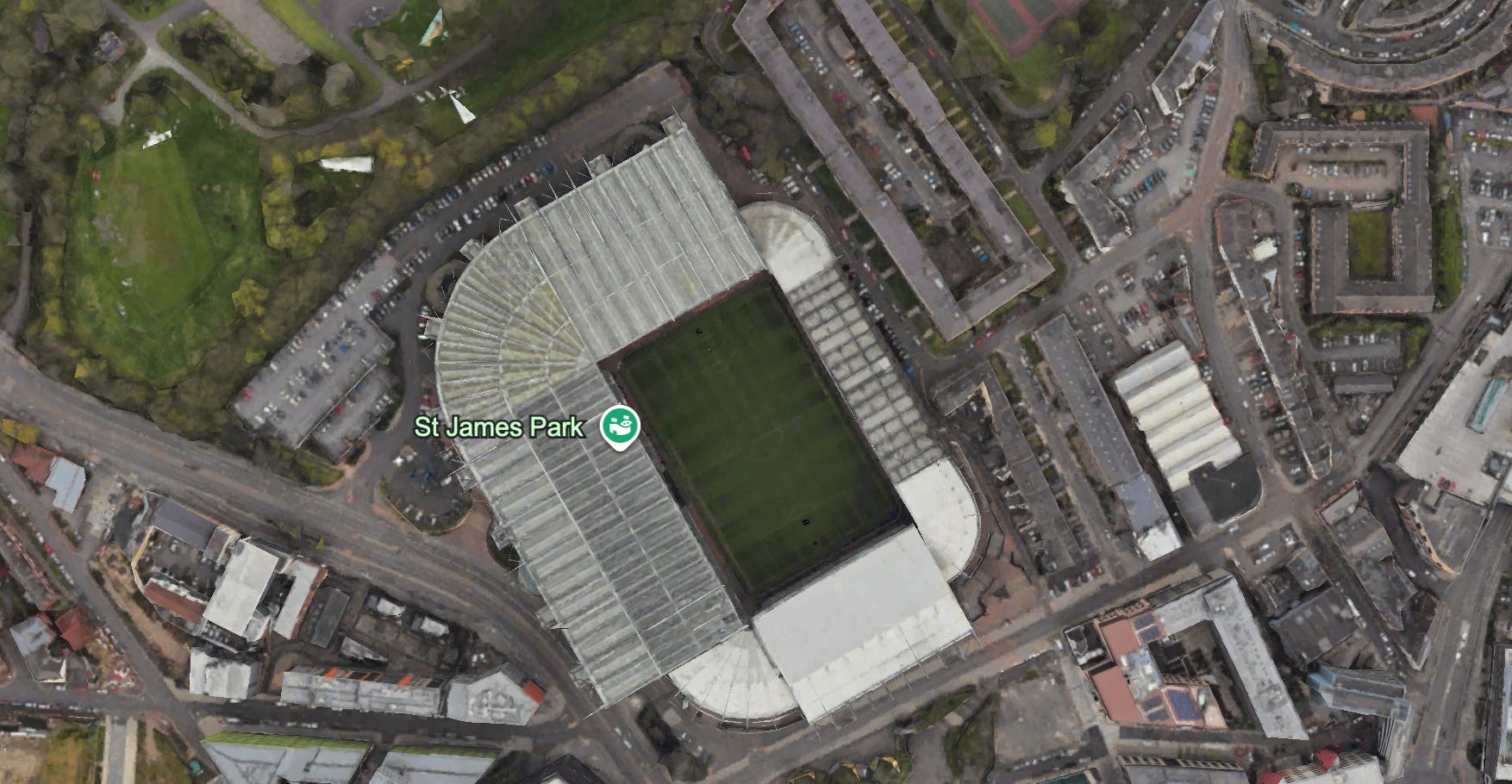
Stadiums, based on their design, either have porous, lossy boundaries with their surrounding environment or hard, brittle ones. As an example, St. James’ Park, where EPL team Newcastle United plays, has a lossy boundary. It is tightly woven into the city grid, where it becomes part of daily life whether you like it or not. St. James’ Park is also 100 years old and has accumulated several generations of thick local narrative and history.
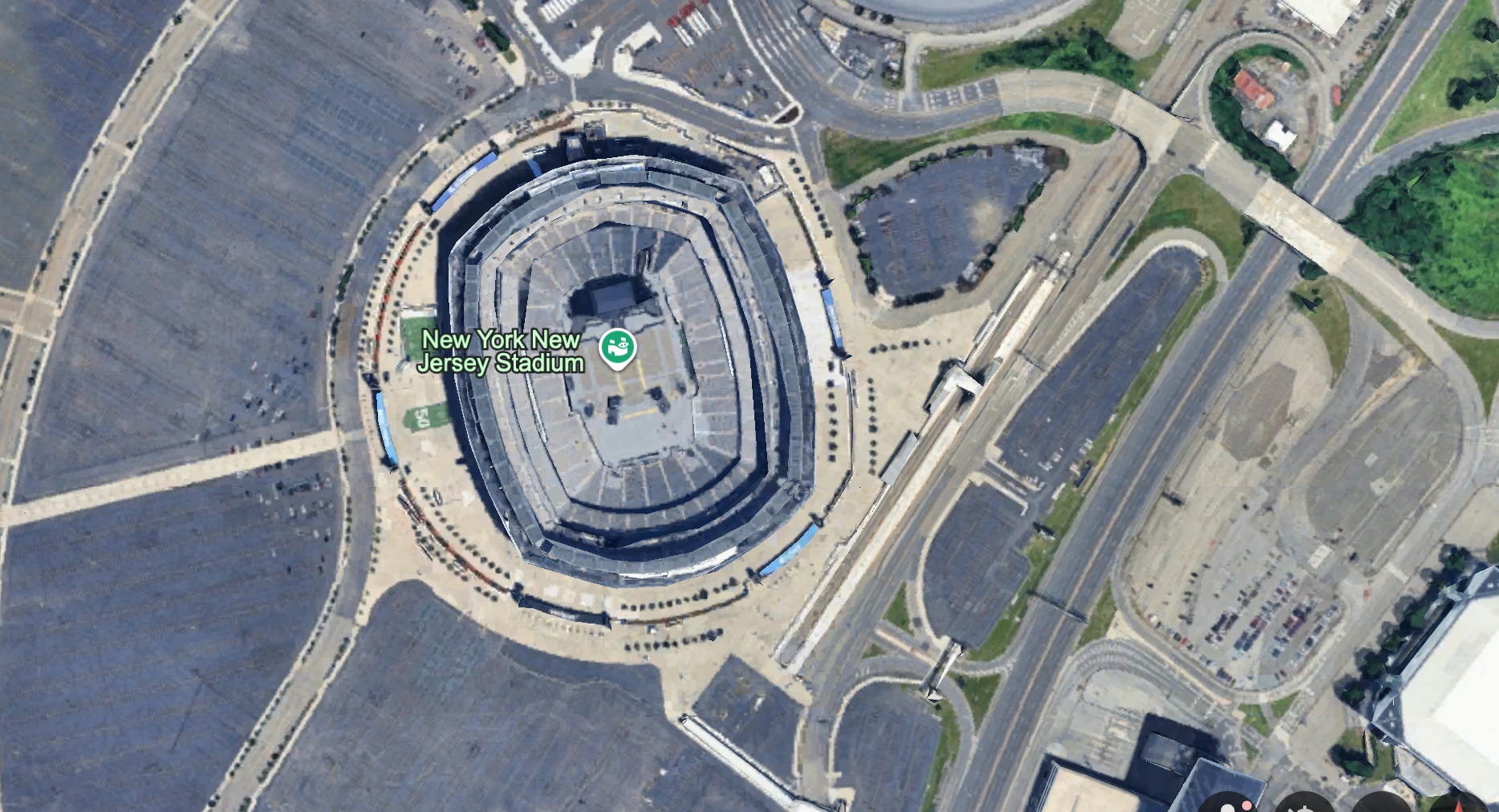
On the other hand, MetLife Stadium, where the World Cup final was played, has a hard boundary. It is cut off from the rest of the city, is surrounded by paved lots bigger than the stadium itself, requires you to carve out time to get to it, and can be safely ignored from your daily life unless you work there. Two New York football teams (the Jets and Giants) play at MetLife in New Jersey. The narratives at MetLife are brand imports from the other side of the river, and thick local narratives are largely absent.
Stadiums also develop a theme park vs. amusement park distinction based on whether they are single sport or multisport and built for a single special event (world cup) or built for the local team/neighborhood. In “The Theme Park: The Art of Time and Space,”1 King and O’Boyle explain the distinction between the two:
“Theme parks are cultural mind maps—symbolic landscapes built as storyboards of psychological narratives. They are the multi-dimensional descendants of the book, film, and epic rather than the spawn of the roller coaster and Tilt-a-Whirl. In the theme park, rides are mechanisms designed to position the visitor’s point of view, much as a camera lens is aligned, moving riders past a series of meticulously focused vignettes to advance the narrative.
Rides also offer the opportunity to expand the experience with physical sensations appropriate to the narrative: the disorientation of flashing light and smoke, the evocative smell of charcoal, appropriate temperature changes, the rush of wind, and the confirmatory sensory input associated with floating or soaring. Rides are but one of the many communications media integrated into the body of the theme park, acting as “executive summaries” to underline the principal themes of the overall theme park experience—an experience that averages eight hours. Time spent on rides comprises a small fraction of the total theme park experience—as little as ten or fifteen minutes.
Unlike the amusement park patron, a theme park visitor can fully engage in the theme experience without ever setting foot on a ride. There are many other features to engage and hold attention: architecture, design, animated and live performance, video, sound and music, light and water technics and the simple fulfillment of pedestrian movement within and among the artfully landscaped themed “worlds.” The theme park is not ride-dependent, while rides are the raison d’être of the amusement park. A theme park without rides is still a theme park; an amusement park without rides is a parking lot with popcorn.
Single sport stadiums accumulate and store memories in the form of museums, sculptures, and permanent names for their stands. They accrete into cultural mind maps replete with thick narratives.


Multisport stadiums and stadiums built for special events, on the other hand, resemble Rem Koolhaas’s notion of Junkspace – memoryless structures that can be transformed and discarded at will.


Based on these design characteristics (boundary and purpose), stadiums have high or low permeability to carnival time, and either high or low archival density. High permeability indicates a porous boundary and an experience embedded into daily life. Low permeability indicates a harder, brittle boundary and a lack of embedding into civic life (you might not even know what’s happening). High archival density is the result of an accumulation of local memories (both personal and civic) alongside the evolving history of teams and heroes.2
Here’s a 2x2:
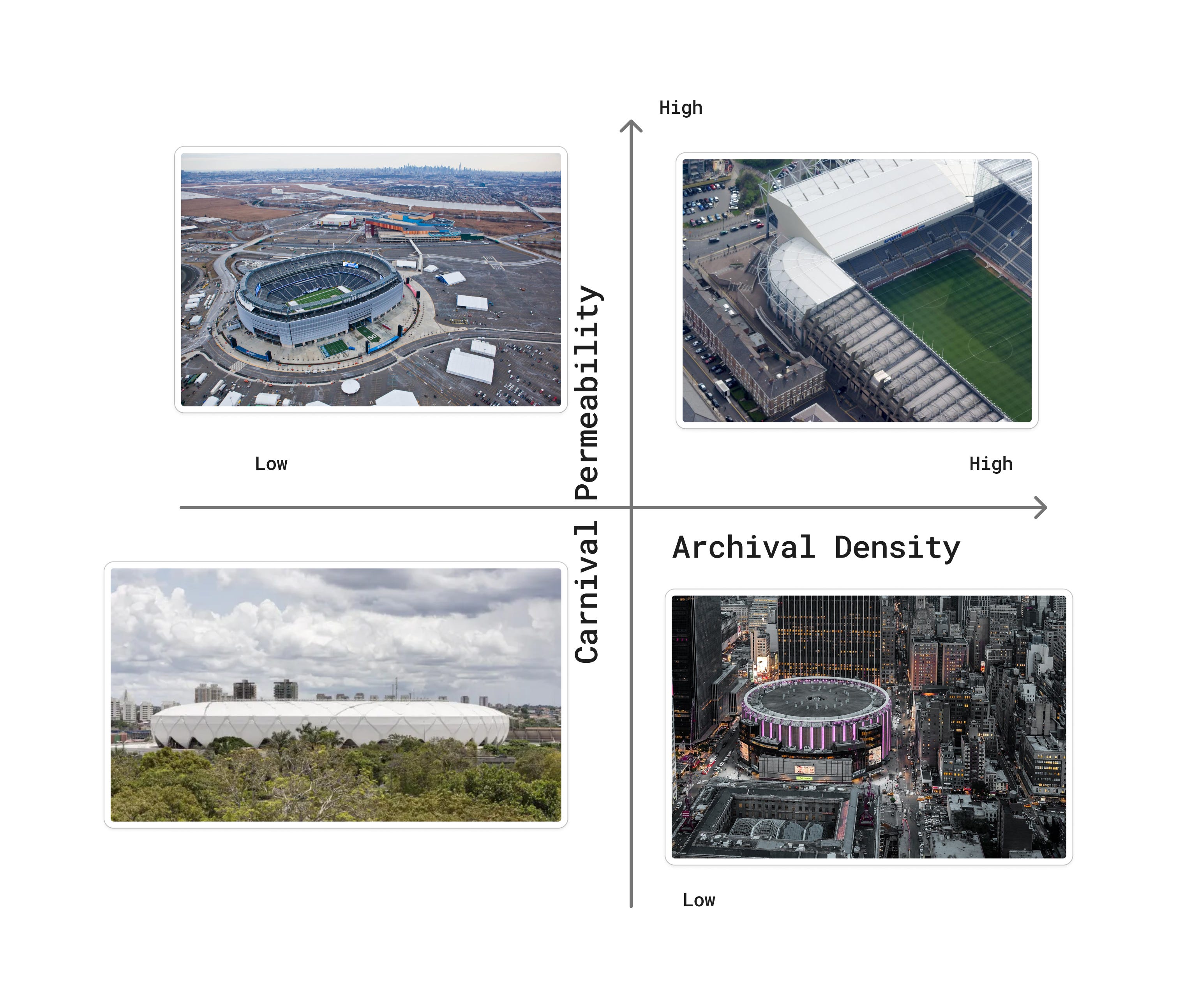
Living Civic Ritual (HA-HC): St. James’ Park is a living civic ritual, where the carnival pulse of Newcastle United (crowds, chants, games, disorder, celebration) sediments into public memory through statues, trophy cabinets, heroes and villains, and inherited stories. This process of converting carnival time into archival sediment generates meaning both for the private individual and for the city. That meaning then charges the next iteration of the carnival. This may be part of the reason you don’t hear about English football clubs being relocated from one place to another (a common occurrence in the United States). Both the owners of the club and the people are engaged in an infinite game of converting carnivals into meaningful experiences of archival time.
Monumental District (HA-LC): Madison Square Garden is the epitome of a monumental district. There is a thick archive of history and stories at MSG. Both the Knicks and Rangers play there. But it also hosts events like, uh... Taylor Swift’s wedding. Even though the place is thick with stories and history, it is not permeable. Perhaps owing to the large monolithic structure and strict boundary, the carnival does not get sustained at the street level. There are occasional examples like the NBA playoffs where there is carnival permeability, but it is not sustained the way it is at St. James’ Park year-round. Such places are always rotating between activating archives — transforming into Knicks territory during the playoffs, then rolling around to become a wedding venue, then an international pop concert.
Stranded Event Infrastructure (LA-LC): Sometimes countries undertake severely misguided attempts to build stadiums for a single event. All those stadiums fall into this category. Perhaps the most iconic of these is the Manaus football stadium deep in the heart of the Amazon, which was built by the Brazilian government to host the 2014 World Cup and has barely been used since. Local citizens consider it a blight and a waste of money. That seems to be the case with most stadiums built for that World Cup. Both FIFA and other international sports bodies seem to have moved away from this practice.
Event Carnival (LA-HC): MetLife Stadium, where the World Cup took place, is a marooned island. FIFA changed the name to NYNJ Stadium for the tournament. It is surrounded by a large parking lot. Two football teams share the stadium during the NFL season. The carnival time that unfolds here is spatially expansive but temporally discontinuous. The parking lots that host fan fests and tailgates stretch around the stadium. You can feel the rhythm and energy of the events all the way to Manhattan, but these don’t sediment into legible archives or local history and day-to-day life. Another example of this is Stadium 974 in Qatar. Constructed from … yeah …974 shipping containers for the 2022 World Cup, the stadium was disassembled after the tournament ended. Interesting to note that Stadium 974 wanted to prevent archival sedimentation, but the actual construction ended up producing more greenhouse gases than a permanent structure would have, so it ended up leaving a rather disreputable archival trail for future stadium architects.
The 2x2 may lead you to conclude that only older stadiums can create high carnival permeability, or that HA-HC is a European phenomenon. I don’t think that’s necessarily the case. One reason Americans are loyal to college football is that games happen in single-purpose stadiums with archival density. Places like Michigan Stadium (the “Big House,” 1927), Ohio Stadium (1922), and Tiger Stadium at LSU (1924) are woven into the surrounding college towns and carry a century of local ritual.
Baseball stadiums went through a modernization phase in the mid-20th century, where a lot of the newer stadiums were “concrete doughnuts” like Three Rivers Stadium in Pittsburgh, Riverfront in Cincinnati, and Veterans Stadium in Philadelphia, most of them shared with NFL teams and marooned in suburban parking lots. But in the late 80s and early 90s there was a revival of the classic baseball park, kicked off by Oriole Park at Camden Yards in 1992, which deliberately took its cues from Fenway and Wrigley, incorporated the old B&O warehouse into its outfield, and re-embedded the stadium into downtown Baltimore.
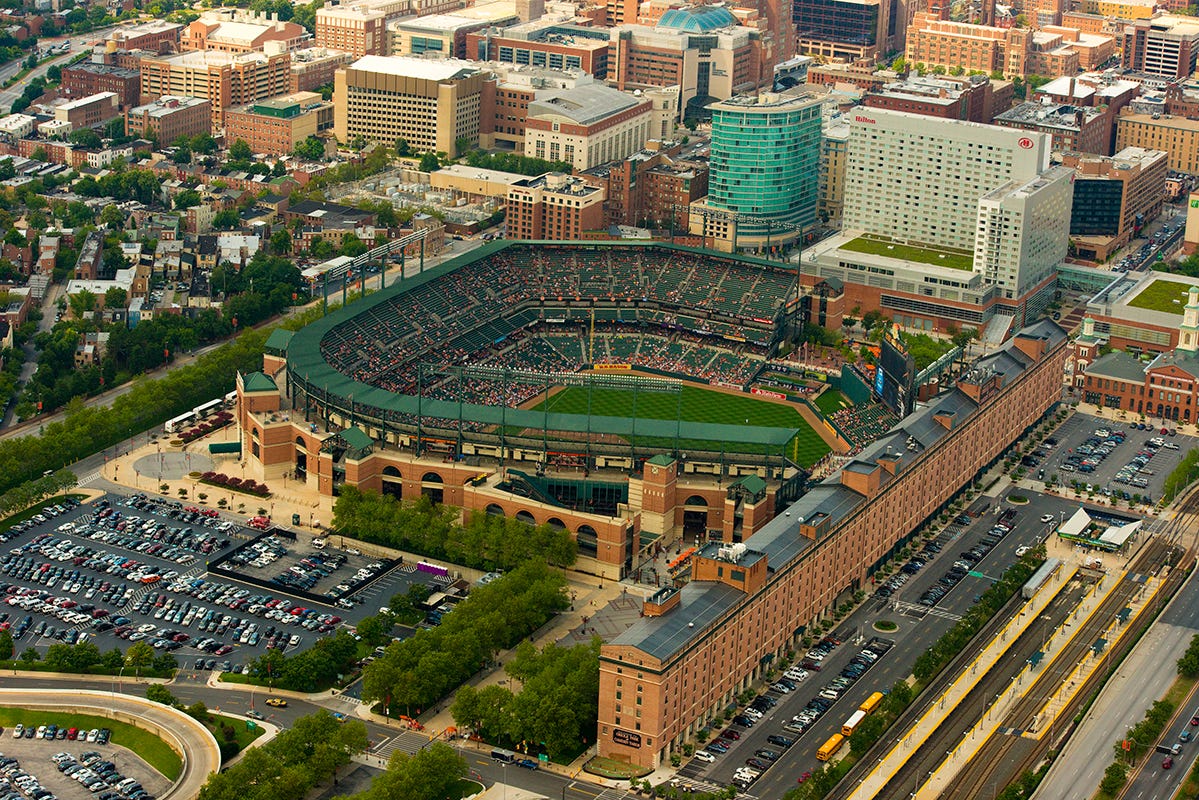
Camden Yards was so successful that nearly every ballpark built since has followed its template – Jacobs Field in Cleveland (1994), Coors Field in Denver (1995), PNC Park in Pittsburgh (2001), and Petco Park in San Diego (2004), all single-purpose and stitched into the urban grid. These are design decisions that depend on the place, the sport, and the degree of openness of both to carnival permeability and archival density.
Found this essay from Frontierland by Sarah Perry
I always enjoy the threads you pull, man. This is a great 2x2 and I think it deserves a deep exploration across various types of civic infrastructure! Vibrant town squares and various failed versions would be really interesting to think about more.