
The Two Memories
Text-first vs phone-interrupt, private vs public memory
A couple of months ago Venkatesh Rao sent me one of his tweets from 2018 and said that it is related to the Archival Time vs Carnival Time thread I’ve been chasing down (emphasis mine):
I suspect the deepest schism in the world today is not any of the obvious ones (left/right, race, generations, gender, auth/lib, 1%/99%) but some non-obvious one induced by technology. My candidate is asynchronous people vs. synchronous people. Text-first vs phone-interrupt.
This tweet has been rattling in my head for a while and I think I finally have a thesis. The schism between asynchronous people and synchronous people is downstream of their preferred way of intensifying the memories of day to day life. Asynchronous people are a class that became more predominant post printing press, during the rise of what McLuhan calls visual culture. This class has more affinity for memory practices that are personal and individual, such as memory palaces, bespoke note taking methods, and other archival methods of remembering. Synchronous people remember by being constantly attuned to a larger body, something larger than themselves, such as festive experiences, intense relationships, gooning1, and other carnivalesque practices. The constant attunement intensifies memories. The former is a private and contemplative practice while the latter is a public and embodied practice.
This isn’t the same as introverted vs extroverted. An asynchronous person can be deeply social, but when it comes to what makes an experience actually take hold in memory, they reach for a personal system. The experience has to be processed through a private apparatus to become intense. A synchronous person might be plenty solitary in other ways, but their memories gain weight through sustained contact with a larger body — crowds, relationships, a live feed, or a group chat that they can constantly be attuned to. The distinction is whether intensity is something you produce alone or something you have to stay plugged into.
It’s hard to define this distinction clearly for postmodern humans because we live in a time where most of our memory lives in media that has archival properties (from print to phones), yet we do have an individual preference for one or the other. Let’s look at examples of intensified memory practices prior to the printing press.
Processions to Memory Palaces
In Craft of Thought (h/t Kei Kreutler), Mary Carruthers writes about the role that processions played in developing civic memory in the 4th century. In the turf war between Christians and Pagans over the city of Daphne, a Christian ruler named Gallus introduces the relics of martyr Babylas into a pagan site dominated by Apollo. Later on, emperor Julian attempts to re-introduce paganism into Daphne by removing the remains of Babylas from the site and constructing a temple to Apollo. The Christians respond with a procession, during which the temple that Julian built catches fire. The Christians see this as divine retribution and the triumph of Babylas. Julian attempts to reclaim the site through processions and spectacles of his own. The processions become a device to create public memory of the events. Carruthers writes:
The events were conducted through processions and festivals; citizens acted like figures in a mnemonic ‘place’ or scaena. The processions created memorable images and structured collective memory.
Julian countered with his own theatrical processions—parades of prostitutes and sacrificial offerings—attempting to reclaim the symbolic order of Daphne.
But what is at stake is not objects themselves but the pattern, the scene in which meaning is embedded. These processions were not passive spectacles but cognitive pathways—ways of moving through memory.
And why did god not destroy the emperor outright or reduce the temple to rubble? Because that would not create the requisite public memory:
A sudden divine act would awe observers, but the memory would fade. Fire, by contrast, leaves a lingering, interpretable sign—one that can be narrated, remembered, and contested over time.
Now, contrast this with the practice of religion post the printing revolution in Europe. People who experienced and memorized the scripture through public readings by priests suddenly had access to a private reading experience where they could read the bible contemplatively and interpret it in their private memory. This private reading practice was one of the biggest disruptions to Christianity, one which Catholics failed to adapt to while Protestants successfully utilized it. It is also not surprising that the rise of the printing press coincided with a renewed interest in personal memory practices such as memory palaces.2
Participation in processions or carnivalesque events creates a particular form of memory practice that is EMBODIED and PUBLIC, while the practice of memory through archival mediums such as reading is PRIVATE and CONTEMPLATIVE.
With that in mind we can make the following 2x2.
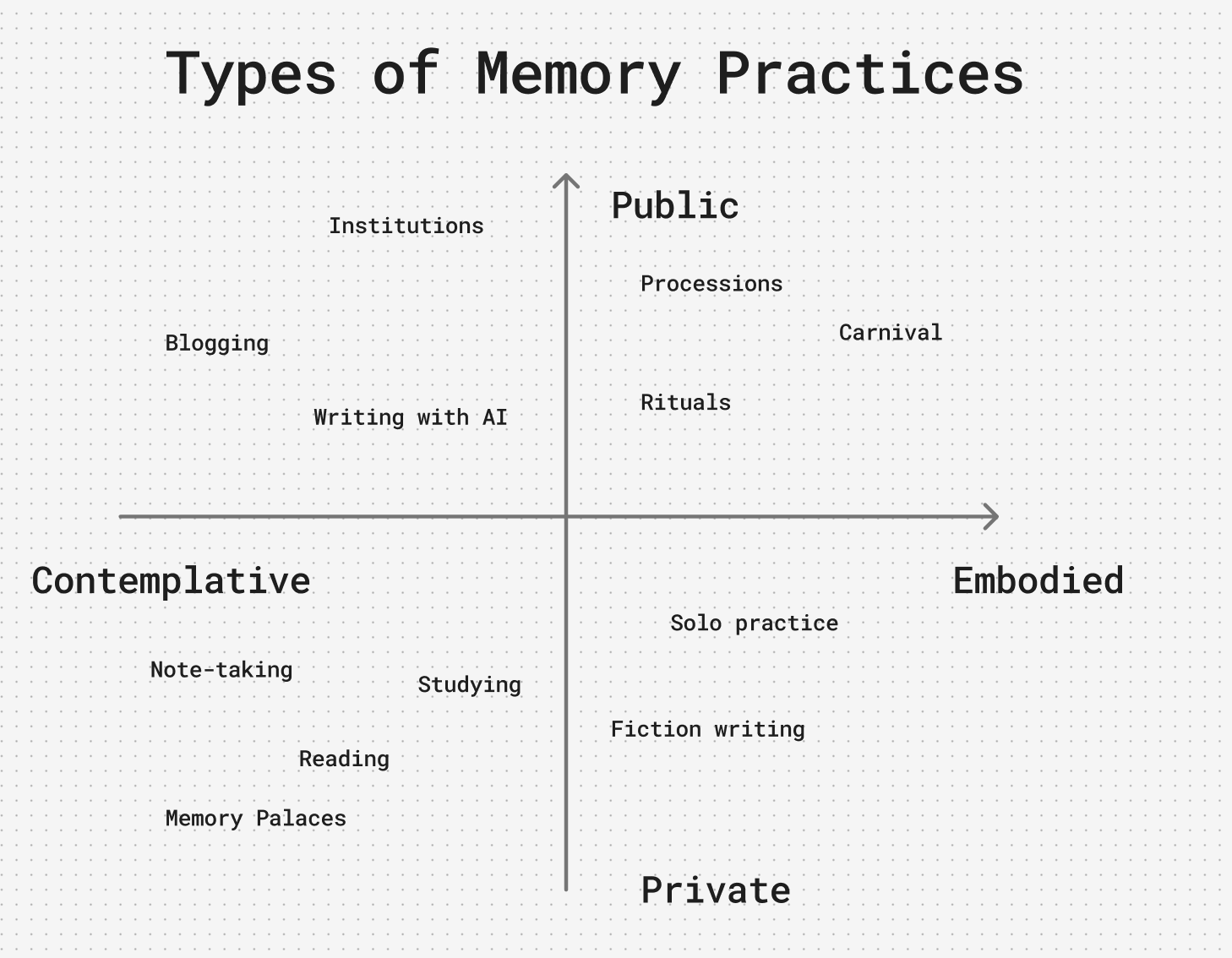
Because of the effects of technology, some of these memory practices shift from quadrant to quadrant. For example, prior to blogging and the internet, a lot of public thinking existed in the realm of embodied and private memory practices, except for institutionally approved editorials, newspapers, and such. Blogging produced a glut of working in public and working with live ideas compared to the previous era.
Writing is an activity that most of us engage in which is contemplative, but also embodied depending on the type of writing, temperament of the writer, etc. Note taking is contemplative and private while writing fiction where you’re attempting to embody multiple characters is embodied and private. Writing produces artefacts for the public and contemplative layer — for example, fiction writing leads to the production of genres and tropes, which is public and contemplative. It also produces fandom, which is public and embodied.
The primary characteristic of the private sphere is that you operate by fixing reference points within your local maxima. Reading, for example. When you’re reading a book, you are engaging with a fixed object. When you’re re-reading your own notes from several years ago, you are interacting with the fixed version of an archival self that you created. In solo practice, such as running or meditation, you are using your past performances or experiences as a reference point for the activity.
In the public sphere, on the other hand, you are always dealing with a common knowledge problem3. You are always unsure if everyone else knows what you know, and they know that you know. Common knowledge is always evolving and changing. The way the common knowledge problem is solved is by constant attunement with others. Institutions do the job of fixing common knowledge in a particular sphere of activity. They become obsolete when they are unable to maintain common knowledge. Influencers and network intellectuals create common Schelling points around which others organize. In more embodied cases such as hooliganism or carnivals, you are constantly attuning yourself with others in order to regulate your own behavior. The objective is to rise above the status of an individual and become part of a force that is greater than yourself.
New forms of media emerge from combining private and public memory practices in new ways. In Otaku: Japan’s Database Animals4, Hiroki Azuma writes about anime fans who collect behaviors and characters instead of engaging with the story. This is comparable to how fans of Star Trek or Star Wars obsessively collect information or artefacts relating to these fictional universes. Fictional universes then combine the contemplative and private practice of reading with the public and embodied practice of collecting and being in attunement with other fans.
Technology Changes Sphere of Practice
The printing press was a type of technology that, as I stated earlier, moved memory practices from the public sphere to the private sphere. Scripture became something personal. The sight of someone reading the newspaper alone in a coffee shop became common and desirable among Renaissance men.
Artificial Intelligence is a type of technology that moves more and more memory practices from the private sphere to the public sphere.
Let’s take writing again. When you’re using an LLM to write, the activity of writing moves from a private memory practice to a public one. If you think of LLMs as archival slices of a large corpus of knowledge, then in the process of writing with an LLM, you’re constantly attuning yourself to the archive. Bad AI slop is the result of poor attunement with the machine. From this example, you could see why synchronous people are more likely to be against LLMs because it threatens their preferred way of intensifying memories.
My hypothesis is that our societies have gotten complex enough that we need to constantly interact with hyperobjects to create new types of knowledge but also to stay in touch with reality. LLMs are a type of archival hyperobject. Take Terence Tao’s example of mathematical proofs that any one person alone cannot verify, or the economic warfare between Iran and the USA that not one or two institutions can model. The complexity of modern life now exceeds what private memory practices can handle, so we’re forced into public attunement with archival hyperobjects whether we like it or not, and LLMs are the most obvious instance of this. Crises like the pandemic response or the 2008 financial crisis show that the relevant knowledge needed to survive or avoid future crises is always changing and evolving, which needs an archive that you can be constantly attuned to.
The technological futures imagined by synchronous people tend to be different from those of asynchronous people. This explains a lot of the kneejerk techno-optimism and techlash on either side. Asynchronous people imagine archival selves — people acting as managers of factories, generating fictional universes with LLMs. Their fears are things like AGI, a type of intelligence that does not need humans to generate memories or remember them. Synchronous people imagine futures in which everyone has an AI boyfriend or girlfriend, as in they fear that the attunement of human-to-human will be replaced by human-to-machine. Their ideal future is some kind of solarpunk communal slop where everyone is gardening and sharing things with each other.
This year has already seen the intensification of the schism between synchronous and asynchronous people, and the future looks like one where our memory practices become more public but remain asynchronous and disembodied. But once the techlash crisis has dissipated for synchronous people, we will enter an era where we need new types of synchronous skills to attune with each other because the archives we’ve built are too complex for private contemplation alone.
Epilogue
I visited the LBJ ranch last weekend and was struck by how well documented LBJ’s life is. I looked a bit more into this and found that LBJ was the first president to have a personal photographer, and apparently he was known to have secret recordings of all his meetings, and about 2000 hours of oral history material that he personally recorded. But, he was also known to erase parts of his history that he wanted to hide or was not proud of. He was also an antisocial jerk. Seems like he was a man keenly aware of how to create an archival self. The perfect asynchronous man archetype. I asked Claude to rank the library archives of presidents post World War Two, and LBJ ranks second (71 million textual records) below Clinton (79 million textual records), who served two terms to LBJ’s one and a half, not to mention Clinton was president in the 90s when documentation expanded with new technology.
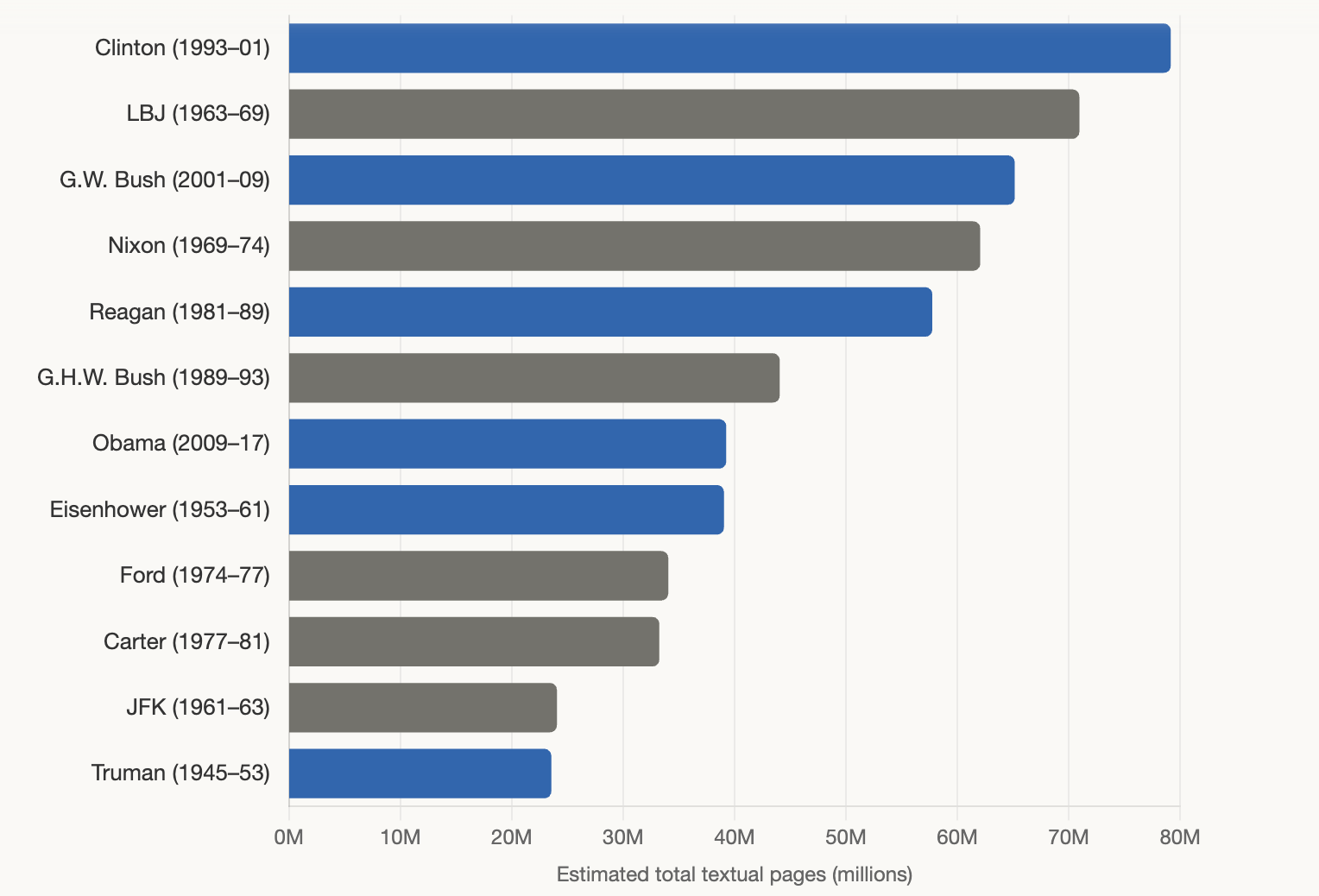
Past 2000, most of the data was electronic, hence why Obama and George Bush rank lower in the rankings, but the actual material produced after 2000 dwarfs anything produced by previous presidents, once again highlighting that the internet made the asynchronous vs synchronous divide5 much less legible because both types of people could now reside in the same medium.
Kei has written extensively about history of Artificial Memory
Title inspired from C.P Snow Two Cultures
Lot to chew on here... One thought though is that sometimes ppl with deep async modalities find a way to cut through the synced up noise particularly on the socials... Here I am thinking of many creators with highly disciplined monk like content consumption habits and that's part of their production...